͏‌ ͏‌ ͏‌ ͏‌ ͏‌ ͏‌ ͏‌ ͏‌ ͏‌ ͏‌ ͏‌ ͏‌ ͏‌ ͏‌ ͏‌ ͏‌ ͏‌ ͏‌ ͏‌ ͏‌ ͏‌ ͏‌ ͏‌ ͏‌ ͏‌ ͏‌ ͏‌ ͏‌ ͏‌ ͏‌ ͏‌ ͏‌ ͏‌ ͏‌ ͏‌ ͏‌ ͏‌ ͏‌ ͏‌ ͏‌ ͏‌ ͏‌ ͏‌ ͏‌ ͏‌ ͏‌ ͏‌ ͏‌ ͏‌ ͏‌ ͏‌ ͏‌ ͏‌ ͏‌ ͏‌ ͏‌ ͏‌ ͏‌ ͏‌ ͏‌ ͏‌ ͏‌ ͏‌ ͏‌ ͏‌ ͏‌ ͏‌ ͏‌ ͏‌ ͏‌ ͏‌ ͏‌ ͏‌ ͏‌ ͏‌ ͏‌ 
Is this email not displaying correctly? View it in your browser.
Logo
Image description

Chapala Birders News - August 2026

Community News & Sightings

100 Species Sighted Last Month by Duncan Poole

There were 100 species reported this past month for the lake area. The complete list is shown at the end of this newsletter.

Interesting species sighted:

  • 2 Olive Sparrows, July 15th at Estación Bombeo.


Donations are appreciated💸💰

We are extremely grateful to Kitty Gordon and Alejandra Diez for their donations to Chapala Birders this June. All donations are used to cover expenses such as the costs of the website hosting and the newsletter. If you wish to donate, please give it to your birding leader to add it to the donation box, or email [email protected] for options.


Birding Ethics: Please remember to follow the ethics of birding during outings.

Feature Bird: Brown-headed Cowbird 

(Molothrus ater) [BHCO] by Jules Evens

Image description

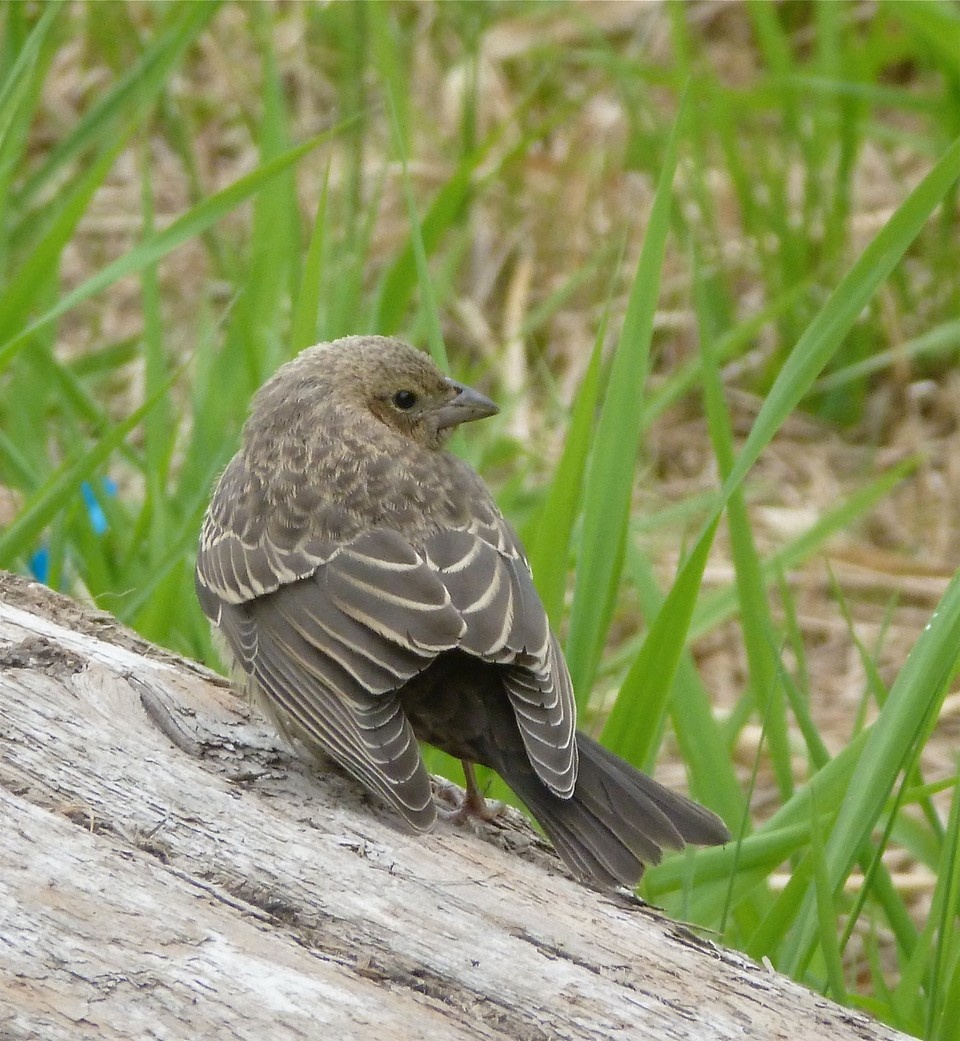
Juvenile Brown-headed Cowbird (Molothrus ater) [BHCO]

Brown-headed Cowbird

Prior to the European colonization of North America, the Brown-headed Cowbird was known as the “Buffalo Bird” because it followed the bison herds across the prairies feeding on insects and seeds that were exposed in soil trampled by the hooves of those vast herds. So, their original distribution was limited to the short-grass plains in North America that bison frequented. As the landscape was converted to agricultural uses by European settlers, and as wagon trains carved paths across the prairies, cowbirds expanded their range across North America and into Mexico. This relatively recent range expansion has had significant impacts on many native birds.


The cowbird is a “brood parasite,” that is, it does not nest and raise young on its own, rather lays its eggs in the nests of other birds. These “hosts” often raise the chicks as if they were their own. Females cowbirds can lay upwards of 40 eggs in a season; this fecundity optimizes the chances that some of the eggs will survive. The list of host species is large and includes some species that have been drastically affected by the parasitism, most notably the endangered Kirkland Warbler. Remarkably, over 220 species ranging in size from warblers to meadowlarks have been documented as cowbird hosts. Some birds recognize the odd egg in their nest and reject it. Yellow Warblers may bury it beneath the nest material; thrashers and catbirds eject the intruder’s egg from the nest. Gnatcatchers may abandon nests that contain a cowbird egg.


The genus name, Molothrus, may translate from the Greek (molobros) as “greedy begger” and the species name, ater, means “dull black” in reference to the male’s plumage. “Cowbird” describes the bird’s habit of gathering around livestock. Having evolved to follow bison herds, it is a nomadic species never settling in one place long enough to build a nest and raise a brood, therefore adapting to this itinerant lifestyle by becoming a brood parasite and leaving the family duties to others. Another species found in the Chapala area, the Bronzed Cowbird (Molothrus aeneus), is also a brood parasite. It’s slightly larger and the male has a red eye. Both cowbirds are in the family Icteridae, which includes the orioles, meadowlarks, and blackbirds, but the cowbirds are the only members of this family with this kinky breeding behavior.

Image description

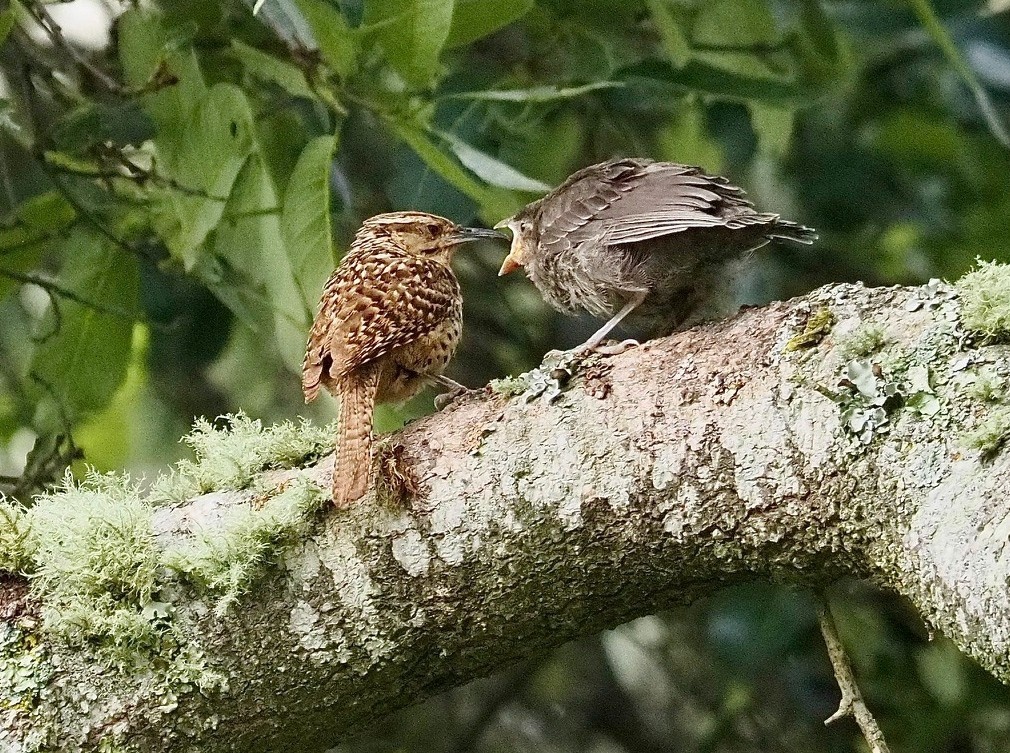
Fledgling Cowbird and Spotted Wren. Photo by Cheshta Buckley

Image description

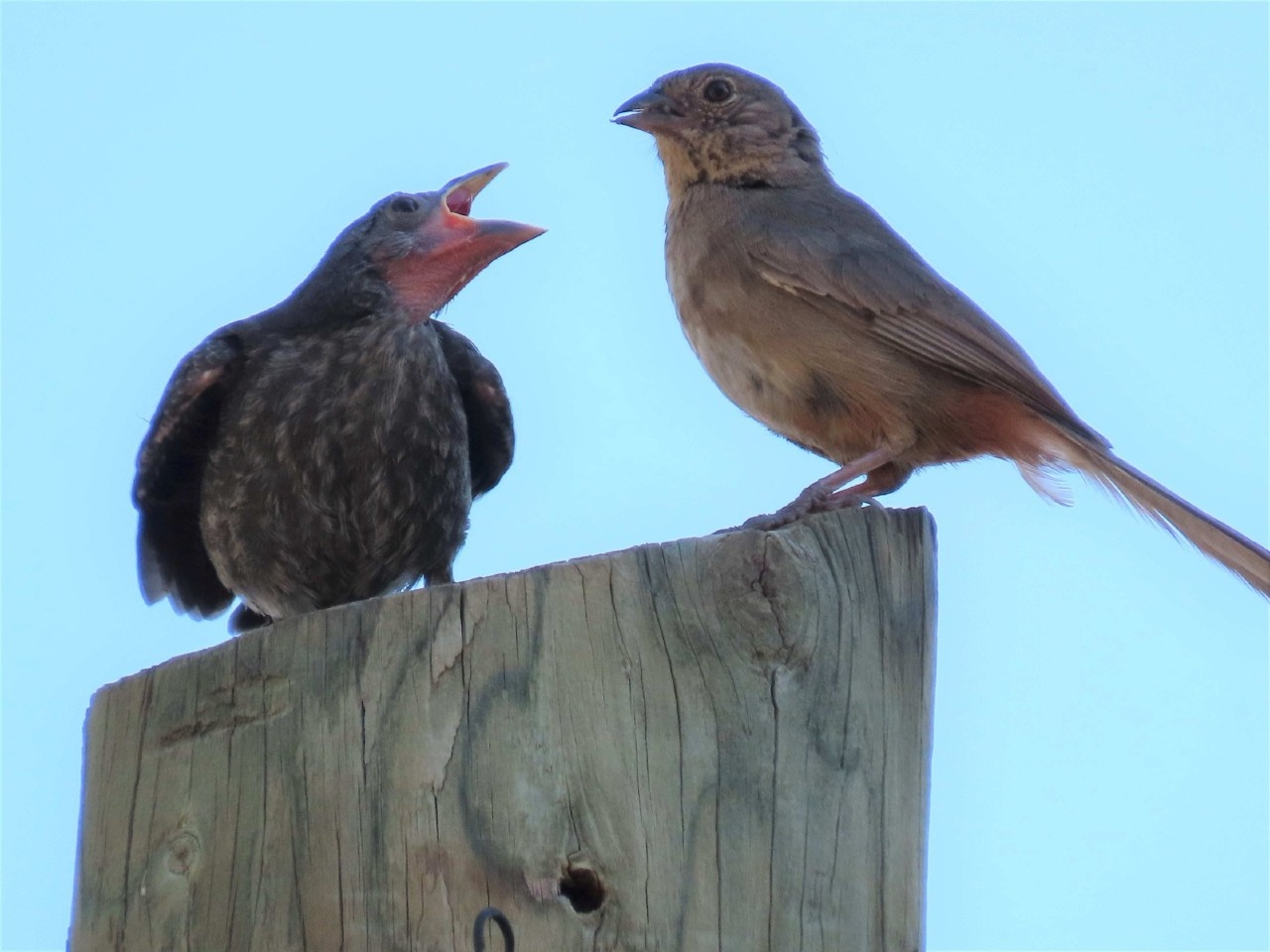
Fledgling Cowbird and Canyon Towhee. Photo by Mugs McConnell

Motus station coming to Chapala?

Lake Chapala is an important migratory route for all sorts of animals. It is the largest Lake in Mexico. Yet there are no radio tracking antennas on Lake Chapala. Did you know not only birds and monarchs migrate but bats and dragonflies do, too.  MOTUS.org is a monitoring system that helps scientists and researchers track the migrations of many species. We first looked into collaborating with MOTUS 3 years ago when we took a banding class and helped raise the first inland MOTUS station in Mexico. At that time there were only 25 MOTUS stations all along the west coast of Mexico. But as of May 2026, there are 75 and growing. We, Kate and Carl Anderson, have offered a place to raise a MOTUS station in collaboration with EcoKaban who studies and tracks Snowy Plover. Here in Mexico it looks like if we want to build a station we must pay for it all ourselves. We will also be maintaining the station over the years [internet service 24/7 & electricity]. We hope to track everything - birds, bats, dragonflies and especially Monarch butterflies. It is exciting to us to be able to really help science is tracking all of these species so that we may gain a better understanding of migrations.  If you would like to know more, please feel free to contact Kate and Carl at [email protected]. Or go to the MOTUS.org site.  It is truly a marvel!

Upcoming Bird Trips

Our bird-walks are open to all those interested in birds; beginners & experienced birders. We always have knowledgeable birders on hand to identify the species. We have a limited number of extra binoculars available upon request in advance of trip. Trip leaders will have available Chapala Bird ID cards for $200 pesos.

————

During these outings social conversations are limited so we do not scare the birds we are observing. Birders can gather for coffee or a meal to socialize later.

————

We try to limit most car trips to 3-4 vehicles / 12-16 people. Larger convoys are hard to manage. If you are being given a ride we suggest that you make a contribution to your driver for gas and tolls. All contributions are voluntary and much appreciated by drivers to offset their expenses.

_______

WARNING! Rainy season is chigger season! Wear long pants and sleeves. Tuck the pants into your socks and apply plenty of insect repellent around seams and exposed areas.

1st SUNDAY OF EVERY MONTH: On August 2nd there will be an informal birding walk along the Allen Lloyd Trail. Meet up at 8am with local and visiting birders in this very accessible location. Expect to see Blue Mockingbird, Happy Wren, and sometimes a Russet-crowned Motmot or Mexican Squirrel Cuckoo. If you need binoculars, contact [email protected]

How to get to the trail head: Drive up the Libramiento a half mile (1 km) from the traffic light at Walmart, then turn left (carefully) as you would for the hospital (Ribera Medical Center). Double back and drive up the left side of the hospital. Keep going uphill another half mile, and park on the only street to your left. Here is a pindrop.  (Note: after parking, we'll walk up the road past the construction. The trail is more a dirt road now - the birding is still good).


On Friday, August 14th, team leaders Kate and Carl Anderson will take you on a trip to La Cañada and the Big Trees. They will meet you at 7.30 am at BLACK COFFEE pindrop which is an empty building on the north east corner of Laguna Mall, across from Walmart on the Libramiento. Vehicles will need high clearance. We will limit this trip to 3 cars/12 people max. Bring water/ food/ coffee/ etc. & a small camping chair.

1st stop: We will access a trail head near La Cañada. This trail requires good hiking boots, possibly a walking stick. We will walk to where we can no longer walk up the canyon (maybe less than a mile). It has a nice wall with vegetation and possibly a water feature. We've only been there once so we're not sure what we'll find. We will probably see Rusty-crowned Ground-Sparrow, Groove-billed Ani, & if we're lucky get a visual on a Brown-backed Solitaire. All along the trail is brush so wear long clothes to not get scratched. If this trail proves too difficult for the group we will switch gears and head for the BIG trees.

2nd Stop: The Big Trees above La Cañada.

This is an amazing place. It has HUGE trees. We have never seen anything like it anywhere in Mexico. There is a river that runs through a wee valley. Jocotepec is building a road to the Guadalajara airport right though this valley. This may spell the end of these trees. See them while you can. Possibly we will see a Pine Flycatcher or Rose-throated Becard.

At this point we will bird, eat lunch/coffee snack. After we sort out the bird list, you may want to loop all the way over to las Trojes from here to see the highway project. From Las Trojes go out by all the berry farms to Jocotepec and home. We will probably just head out to La Cañada and home.  

This may be a long, rough trip. Please confirm your attendance at least 1 week in advance by emailing [email protected] indicating if you can bring a vehicle and take passengers or need a ride. Please have a generous contribution for your driver.  


On Thursday, August 20th, meet team leader Robert McConnell at 8.00am at the Sculpture - at the only traffic light in La Floresta, south-east corner, opposite Restaurant Pranzo (pindrop), departing immediately for Villa Corona on Lake Atotonilco (60 minutes drive). We expect to see various shore birds such as White-faced Ibis and Roseate Spoonbill. Bring your own mid-morning refreshments. There will be a break for snacking about 11.00 am. We will be back in Ajijic by about 1.30 pm. Please confirm your attendance at least 3 days in advance by emailing  [email protected] saying if you can bring a vehicle and can take passengers, or you would like to be a passenger. Be prepared to give a generous contribution to your driver for gas.

Bird Trip Summaries for June by Trip Leaders

On Sunday, July 5th, a group of 13 people went on an outing to the Allen Lloyd Sendero. It was an overcast cool morning after a night of good rains. The Sendero is now showing much green foliage coming back and we had many singing birds on territory. We had excellent views of the Mexican Squirrel Cuckoos, heard at least 2 Russet-crowned Motmots calling repeatedly early on and listened to 4 species of Wrens. We had 2 pairs of Streak-backed Orioles on occupied nests. A satisfying total of 38 species. To see a full list go to https://ebird.org/checklist/S376314093


On Friday, July 17th,13 keen birders joined Kate and Carl Anderson at Casa Tecolote despite the rain threat. We gathered up on the mirador to observe birds. We shared a lot of local bird knowledge with the group. There were a few new birders. It was really fun to see their excitement when they now can pair the sound with the Golden-fronted Woodpecker. A few of us climbed up onto the roof to talk about the MOTUS antenna system we will be installing. After time here at Casa Tecolote we cruised over to La Reservita, touring around and seeing lots of birds. We showed people the simple drip water feature which attracts birds. Then off to the Lake for our final count of 26 species Very fun. No rain fell but the clouds keep us cool and comfortable. For a complete list see https://ebird.org/checklist/S376317396


On Tuesday, July 21st, we had 9 participants in 3 vehicles join John Keeling exploring the Sierra de Tapalpa. We stopped for coffee in the pretty village of Ferrera de Tula, and ended up for lunch in Tapalpa. We recorded sightings of Striped Sparrow, American Robin, Gray-silky Flycatcher, Mountain Pygmy-Owl, Eastern Bluebird, and White-throated Thrush. Because the area we travelled is very large, there are 4 lists totalling 37 species. All participants were very pleased with how pleasant a day it was.

Yolosta https://ebird.org/checklist/S376317311,

Sierra de Tapalpa https://ebird.org/checklist/S376317186,

Presa Juanacatlán https://ebird.org/checklist/S376317039,

Camino a Los Espinos https://ebird.org/checklist/S376317104

Monthly Sightings by Duncan Poole

What is the “Lake Chapala Area” for bird sightings?

We define it as the whole area of the lake plus all land within 15 km (7 miles) from the edge of the lake. We combine sightings for the month from Chapala, Jocotopec, Ixtlahuacán de los Membrillos, Briseñas, Venustiano Carranza, Poncitlán, Ocotlán, Jamay, Tizapán El Alto & La Manzanilla de la Paz.


100 Species were observed around Lake Chapala in July. (in Taxonomic order):

1 Black-bellied Whistling-Duck

2 Fulvous Whistling-Duck

3 Mexican Duck

4 Northern Bobwhite

5 Rock Pigeon

6 Eurasian Collared-Dove

7 Inca Dove

8 Common Ground Dove

9 White-tipped Dove

10 White-winged Dove

11 Mourning Dove

12 Groove-billed Ani

13 Lesser Roadrunner

14 Mexican Squirrel-Cuckoo

15 Mexican Violetear

16 Broad-billed Hummingbird

17 White-Eared Hummingbird

18 Violet-crowned Hummingbird

19 Berylline Hummingbird

20 Common Gallinule

21 American Coot

22 Killdeer

23 Northern Jacana

24 Ring-billed Gull

25 Neotropic Cormorant

26 White-faced Ibis

27 Black-crowned Night Heron

28 Little Blue Heron

29 Tricolored Heron

30 Snowy Egret

31 Green Heron

32 Western Cattle-Egret

33 Great Egret

34 Great Blue Heron

35 Black Vulture

36 Turkey Vulture

37 Cooper's Hawk

38 Red-tailed Hawk

39 Great Horned Owl

40 Ferruginous Pygmy-Owl

41 Russet-crowned Motmot

42 Acorn Woodpecker

43 Golden-fronted Woodpecker

44 Ladder-backed Woodpecker

45 Crested Caracara

46 Monk Parakeet

47 Rose-throated Becard

48 Northern Beardless-Tyrannulet

49 Greenish Elaenia

50 Western Wood-Pewee

51 Vermilion Flycatcher

52 Dusky-capped Flycatcher

53 Ash-throated Flycatcher

54 Nutting's Flycatcher

55 Brown-crested Flycatcher

56 Great Kiskadee

57 Social Flycatcher

58 Sulphur-bellied Flycatcher

59 Tropical Kingbird

60 Cassin's Kingbird

61 Thick-billed Kingbird

62 Golden Vireo

63 Loggerhead Shrike

64 Northern Rough-winged Swallow

65 Barn Swallow

66 Cliff Swallow

67 Bushtit

68 Canyon Wren

69 Bewick's Wren

70 Spotted Wren

71 Happy Wren

72 Sinaloa Wren

73 Blue Mockingbird

74 Curve-billed Thrasher

75 Northern Mockingbird

76 Orange-billed Nightingale-Thrush

77 Rufous-backed Robin

78 House Sparrow

79 House Finch

80 Lesser Goldfinch

81 Stripe-headed Sparrow

82 Olive Sparrow

83 Rusty-crowned Ground-Sparrow

84 Canyon Towhee

85 Yellow-Breasted Chat

86 Yellow-headed Blackbird

87 Black-vented Oriole

88 Streak-backed Oriole

89 Black-backed Oriole

90 Bronzed Cowbird

91 Brown-headed Cowbird

92 Great-tailed Grackle

93 Gray-crowned Yellowthroat

94 Yellow-rumped Warbler

95 Rufous-capped Warbler

96 Northern Cardinal

97 Black-headed Grosbeak

98 Blue Grosbeak

99 Blue-black Grassquit

100 Cinnamon-rumped Seedeater

John and Rosemary Keeling

John and Rosemary Keeling

Lake Chapala Birders is an informal group of bird observers led by a team of volunteer Chapala Birders on behalf of John & Rosemary Keeling.


Overall Coordinator: Cheshta Buckley

Newsletter: Mugs McConnell

Website: Robert McConnell

Feature Bird: Jules Evens

Monthly Sightings List: Duncan Poole

Bird Trip Leaders & Reports: Cheshta Buckley, Thomas Bravo, Kate & Carl Anderson, Jules Evens, Duncan Poole, John Roynon, Robert Taylor, Robert McConnell, Gerd DeBeer.

Illustrated color folders showing our common birds are available for $200 pesos from your birding group leaders on bird walks. Also available at Diane Pearl’s Gallery, 11am to 4pm, Santa Margarita #23, Riberas del Pilar.


Sign up for this newsletter or send us your exciting bird sightings by visiting our contact page


Check our website: ChapalaBirders.org  There you will find our newsletters, illustrations of our birds and advice on buying binoculars, books & birding apps.

Image description
Image description

Copyright (C) 2026, Lake Chapala Birders. All rights reserved.
Our mailing address is: Calle Santa Isabel #32, Riberas del Pilar (Ajijic), Chapala, JA, 45906 MX

To sign up for this newsletter, go to our website contact page

If you would like to unsubscribe, please click here.
Powered by Sender.net