͏‌ ͏‌ ͏‌ ͏‌ ͏‌ ͏‌ ͏‌ ͏‌ ͏‌ ͏‌ ͏‌ ͏‌ ͏‌ ͏‌ ͏‌ ͏‌ ͏‌ ͏‌ ͏‌ ͏‌ ͏‌ ͏‌ ͏‌ ͏‌ ͏‌ ͏‌ ͏‌ ͏‌ ͏‌ ͏‌ ͏‌ ͏‌ ͏‌ ͏‌ ͏‌ ͏‌ ͏‌ ͏‌ ͏‌ ͏‌ ͏‌ ͏‌ ͏‌ ͏‌ ͏‌ ͏‌ ͏‌ ͏‌ ͏‌ ͏‌ ͏‌ ͏‌ ͏‌ ͏‌ ͏‌ ͏‌ ͏‌ ͏‌ ͏‌ ͏‌ ͏‌ ͏‌ ͏‌ ͏‌ ͏‌ ͏‌ ͏‌ ͏‌ ͏‌ ͏‌ ͏‌ ͏‌ ͏‌ ͏‌ ͏‌ ͏‌ 
Is this email not displaying correctly? View it in your browser.
Logo
Image description

Chapala Birders News - June 2026

Community News & Sightings

117 Species Sighted Last Month by Duncan Poole

There were 117 species reported this past month for the lake area. The complete list is shown at the end of this newsletter.  Interesting species sighted:

  • Mexican Parrotlet, 2 seen, labelled "Sensitive", Undisclosed Chapala location

  • Botteri's Sparrow, 1 seen, May 28th, Escuela Internacional


Highlights of May's Global Big Day! Birders documented more than 8000 bird species in one day! Read about this historic event!


El Ojo del Lago Features Lake Chapala Birders! El Ojo del Lago magazine has a new section called "Outdoor Living", and in the May issue John Keeling wrote an excellent article about birding in the Lake Chapala area. He has outlined very clearly many great locations to see specific species in the area. Check it out here!


Donations are appreciated💸💰

We are extremely grateful for all donations to cover the costs of the Website hosting and the newsletter. If you wish to donate, please give it to your birding leader to add it to the donation box, or email [email protected] for options.

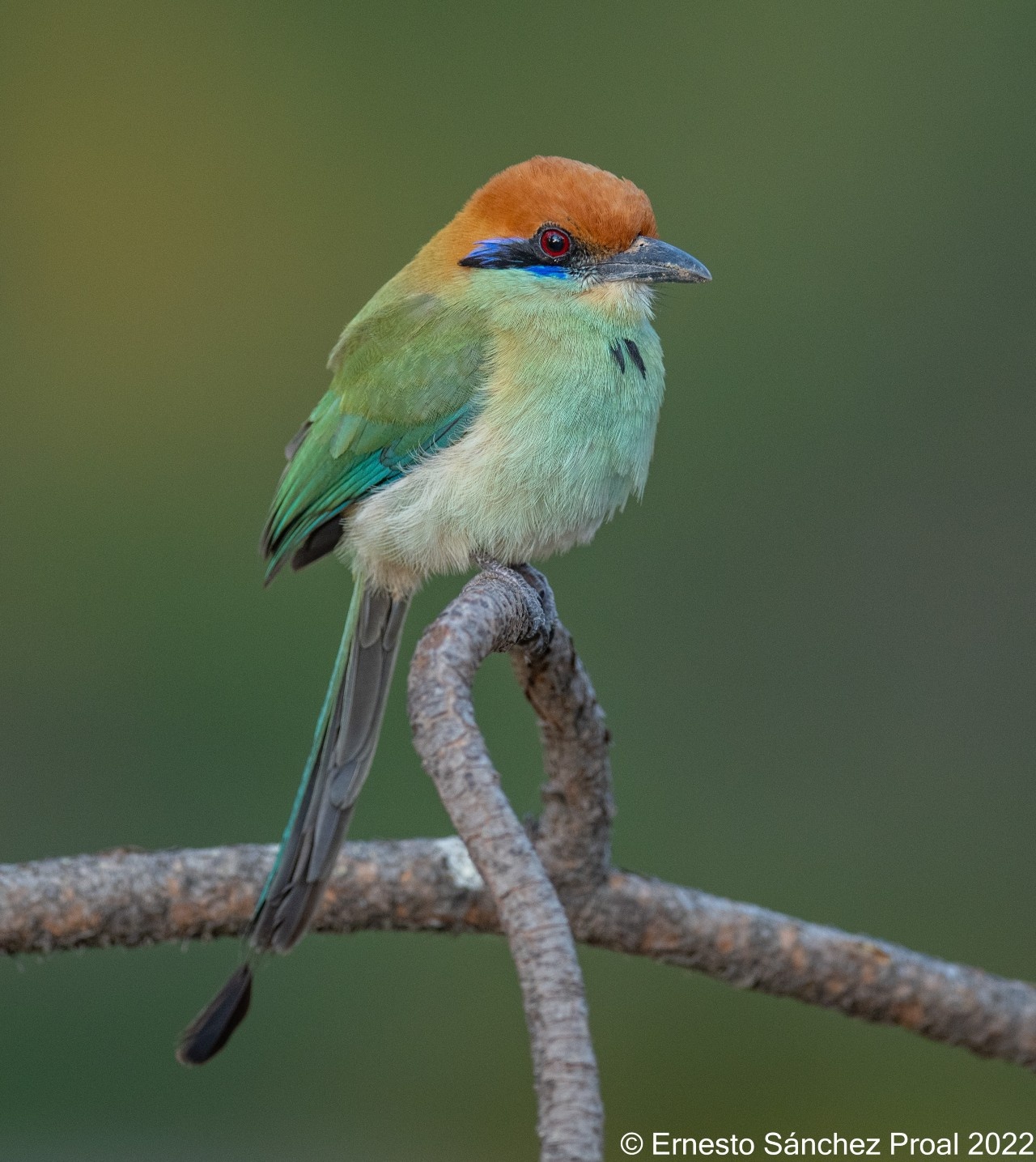
Feature Bird: Russet-Crowned Motmot 

(Motmotus mexicanus) by Jules Evens

Image description

Russet-crowned Motmot (Motmotus mexicanus) [RCMO]

Photo credit Ernesto Sánchez Proal. Used with permission.

Russet-crowned Motmot

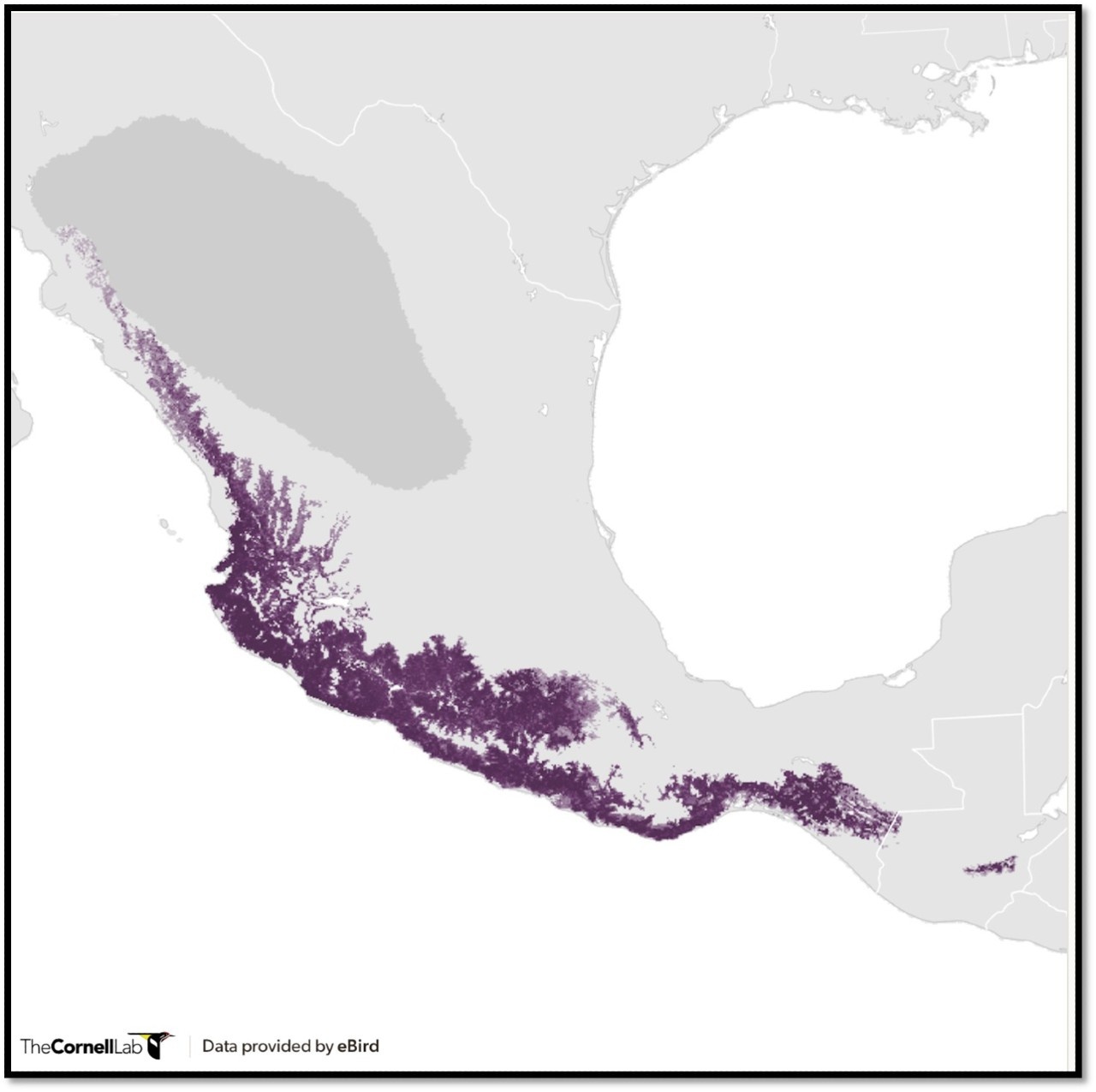
This striking bird, endemic to western Mexico, is represented by three subspecies. A fourth subspecies in the Motagua Valley of Guatemala is isolated (disjunct) from the Mexican populations and may be a separate species. With luck, the motmot can be found in arid shrublands and woodland edges, ranging as high as 1800 m (5900’), therefore our Chapala area is near the upper edge of the distribution. It is a sedentary, non-migratory species, present here year-round.


The plumage of males and females is similar (monomorphic) although females tend to have slightly shorter tails. Motmots are socially monogamous, pairing-up to in the rainy season (May-July). As with most other monomorphic birds the nestling duties are shared—nest site selection, excavation, provisioning chicks. The pair excavates a horizontal tunnel (88 to 170 cm long) with an egg chamber at the end. This burrow-nesting behavior is a limiting factor for the population due to the scarcity of appropriate substrate—loamy, friable soil. The burrows also need to be placed on slopes, in a roadcut, or one a riverbank. Because of these rather strict nesting requirements, RCMOs are somewhat sparsely distributed throughout their range. Furthermore, ground-nests are susceptible to predation of eggs, especially by snakes and iguanas.


Motmots provide a highlight of the day whenever seen, but encounters are rather infrequent. Although they are sizeable birds (30 to 36 cms), they are quite still when perched for hunting, sitting-and-waiting for their prey—snakes, lizards and small invertebrates such as beetles. Fruit eating is apparently not reported (Birds of the World), but perhaps fruit is taken, as with other motmots. The birds are most often located by their calls, very low, deep, and hollow : a single “ook” or a rolling, repeated “krrup-krrup-krrup…” (listen to their calls here)


Motmots belong to the avian order Coraciiformes (from the Latin coracium-“raven-like”) which includes many Old World groups—bee-eaters, rollers, todies, and kingfishers.

Note: This is the most understudied species of motmot in its family (Momotidae), so any behavioral information is of value. Please report any behavioral details to Lake Chapala Birders [email protected] .

Image description

Distribution of Russet-crowned Motmot in western Mexico. Note the isolated population in Guatemala (lower right).

Tip #11 for Birding Ethics

Found a baby bird? Most abandoned birds are perfectly healthy fledglings whose parents nearby watching out for them. Before you succumb to the impulse to rescue the bird, use this guide to determine whether to take action: What to do when you find a baby bird.

Learn more here about Birding Ethics.

Upcoming Bird Trips

Our bird-walks are open to all those interested in birds; beginners & experienced birders. We always have knowledgeable birders on hand to identify the species. We have a limited number of extra binoculars available upon request in advance of trip.

————

During these outings social conversations are limited so we do not scare the birds we are observing. Birders can gather for coffee or a meal to socialize later.

————

We try to limit most car trips to 3-4 vehicles / 12-16 people. Larger convoys are hard to manage. If you are being given a ride, you are expected make a contribution to your driver for gas and tolls ($100 - $400 pesos based on length of trip).

1st SUNDAY OF EVERY MONTH: On June 7th there will be an informal birding walk along the Allen Lloyd Trail. Meet up at 8am with local and visiting birders in this very accessible location. Expect to see Blue Mockingbird, Happy Wren, and sometimes a Russet-crowned Motmot or Squirrel Cuckoo.

How to get to the trail head: Drive up the Libramiento a half mile (1 km) from the traffic light at Walmart, then turn left (carefully) as you would for the hospital (Ribera Medical Center). Double back and drive up the left side of the hospital. Keep going uphill another half mile, and park on the only street to your left. Here is a pindrop.  (Note: after parking, we'll walk up the road past the construction. The trail is more a dirt road now - the birding is still good).


On Thursday, June 18th, meet team leader Cheshta Buckley at 8:00am at the “Sculpture” (see pindrop). It’s at the only traffic light in La Floresta, opposite Restaurant Pranzo). We will depart immediately for the Rosa Amarilla Loop on the south side of the lake (60 minutes drive). Expect to see a variety of grassland birds and possibly a White-tailed Hawk. Bring refreshments for the morning and sandwiches for the 12.30 lunch stop. We will be back about 3.00 pm.

You must reserve at least 4 days ahead with Cheshta at [email protected] indicating if you can bring a vehicle and can take others, or if you would like to be a passenger. No surprise guests please. There will be a maximum of 3 cars and 12 people. Each passenger pays their driver $200 pesos to cover gas/tolls.


On Thursday, June 25th, meet up with trip leaders Kate and Carl Anderson at this hidden little valley "Del Rodeo" between Ixtlahuacán de Membrillos and Atequiza. We have seen many special birds here including the Squirrel Cuckoo, Euphonia, and MotMot. We will meet under some trees and walk first to a balcony to get an overview. Then back into the wee valley. Be prepared to walk on uneven ground. We will gauge how far we go by the group. We could walk up to 2 miles with steep gradients. Bring water and a snack.

You must reserve at least a week in advance in case transportation is needed. Please email Kate and Carl at [email protected] indicating if you can bring a vehicle and can take others, or if you would like to be a passenger. Each passenger pays the driver $100 pesos to cover gas/tolls.

How to get there: Link with directions from google maps

From Walmart it is 14.5 km. Drive up the libramiento towards Ixtlahuacán. After approx 2km, right after you go under the walking bridge across the highway. Once you make the right off the highway, turn right onto Acueducto/JAL 166. Then turn left onto Av. Santiago. It has a round, green “RV “sign high on a signpost. You are on the correct road when you see the cemetery on your left. Continue up the hill. Once you get near the top of the hill turn left onto Del Rodeo.  CAUTION: watch for traffic coming down the hill on your right as you turn left. You know you have missed this turn if the road turns to asphalt. Once you have made the left turn go about 180 metres down the hill. Park on the left near a tall white wall under a big tree. Here is a pindrop.

Bird Trip Summaries for May by Trip Leaders

On Sunday, May 3rd, a group of 8 people enjoyed excellent weather and early morning clear blue skies for a most enjoyable walk up the Allen Lloyd Canyon. 37 species were observed. Some regular favorites showed up, including Warbling and Golden Vireos, 3 species of Wrens and a pair of our favorite Squirrel Cuckoos. In addition we observed 3 Red-Tailed Hawks (1 dark Morph) and 2 Turkey Vultures still lingering in the area… see full list with images. Report offered by Cheshta Buckley.


On Tuesday, May 12th, a group of 8 joined team leader Cheshta Buckley at San Antonio Tlayacapan Malecón. They got to enjoy a relatively cooler morning with overcast skies and clear views across the lake. 38 species were observed including very active Great Egrets on their tree top nest sites, together with a variety of Orioles, Flycatchers and water birds. 2 newly hatched Gallinules in sub adult plumage provided us with the ID quiz of the day and the relief that they had survived predation from hungry Night Herons. For a full list  See full list here 


On Tuesday, May 19th, a group of 7 birders were led by team leader Gerd DeBeer to La Manzanilla de la Paz. Despite the growth in the ravine being very dense, they were rewarded with quality sightings of 30 species. Unfortunately the presa had no shore birds except for 3 domestic white ducks with some chicks. The highlight of the day was the sighting of a pair of Elegant Euphonia foraging on a tree no more than 10 feet away from the group. Elva Johnson captured a video on her iPhone video which you can view in the full ebird checklist link below. Second to this was the sighting of several White-throated thrush, a lifer for many of the group. Other quality sightings were Brown-backed Solitaire, Acorn Woodpecker, Blue Mockingbird, Orange-billed nightingale thrush, and Gray silky-flycatcher. See full checklist.

Monthly Sightings 

by Duncan Poole

What is the “Lake Chapala Area” for bird sightings?

We define it as the whole area of the lake plus all land within 15 km (7 miles) from the edge of the lake. We combine sightings for the month from Chapala, Jocotopec, Ixtlahuacán de los Membrillos, Briseñas, Venustiano Carranza, Poncitlán, Ocotlán, Jamay, & La Manzanilla de la Paz.


117 species were observed around Lake Chapala in May. (in Taxonomic order):

1      Black-bellied Whistling-Duck

2      Fulvous Whistling-Duck      

3      Blue-winged Teal 

4      Mexican Duck

5      Rock Pigeon

6      Eurasian Collared-Dove

7      Inca Dove

8      Common Ground Dove

9      White-tipped Dove

10    White-winged Dove

11    Mourning Dove

12    Groove-billed Ani

13    Greater Roadrunner

14    Mexican Squirrel-Cuckoo

15    Buff-collared Nightjar

16    Broad-billed Hummingbird

17    Violet-crowned Hummingbird

18    Berylline Hummingbird

19    Common Gallinule

20    American Coot

21    Black-necked Stilt

22    Kildeer

23    Northern Jacana

24    Spotted Sandpiper

25    Ring-billed Gull

26    Caspian Tern

27    Least Grebe

28    Pied-billed Grebe

29    Neotropic Cormorant

30    White-faced Ibis

31    Black-crowned Night Heron

32    Tricolored Heron

33    Snowy Egret

34    Green Heron

35    Western Cattle-Egret

36    Great Egret

37    Great Blue Heron

38    American White Pelican

39    Brown Pelican

40    Black Vulture

41    Turkey Vulture

42    Osprey

43    Cooper's Hawk

44    Red-tailed Hawk

45    Ferruginous Pygmy-Owl

46    Russet-crowned Motmot

47    Acorn Woodpecker

48    Golden-fronted Woodpecker

49    Ladder-backed Woodpecker

50    Crested Caracara

51    Monk Parakeet

52    Mexican Parrotlet

53    Rose-throated Becard

54    Northern Beardless-Tyrannulet

55    Greenish Elaenia

56    Western Wood-Pewee

57    Vermilion Flycatcher

58    Dusky-capped Flycatcher

59    Nutting's Flycatcher

60    Brown-crested Flycatcher

61    Great Kiskadee

62    Social Flycatcher

63    Sulphur-Bellied Flycatcher

64    Tropical Kingbird

65    Cassin's Kingbird

66    Thick-billed Kingbird

67    Western Kingbird

68    Golden Vireo

69    Western Warbling Vireo

70    Loggerhead Shrike

71    Northern Rough-winged Swallow

72    Barn Swallow

73    Cliff Swallow

74    Bushtit

75    Canyon Wren

76    Bewick's Wren

77    Spotted Wren

78    Happy Wren

79    Sinaloa Wren

80    Blue Mockingbird

81    Curve-billed Thrasher

82    Northern Mockingbird

83    Eastern Bluebird

84    Brown-backed Solitaire

85    Orange-billed Nightingale-Thrush

86    White-throated Thrush

87    Rufous-backed Robin

88    Gray Silky-flycatcher

89    House Sparrow

90    Elegant Euphonia

91    House Finch

92    Lesser Goldfinch

93    Stripe-headed Sparrow

94    Botteri's Sparrow

95    Chipping Sparrow

96    Lark Sparrow

97    Rusty-crowned Ground-Sparrow

98    Canyon Towhee

99    Spotted Towhee

100  Yellow-breasted Chat

101  Black-vented Oriole

102  Orchard Oriole

103  Streak-backed Oriole

104  Black-backed Oriole

105  Bronzed Cowbird

106  Brown-headed Cowbird

107  Great-tailed Grackle

108  Gray-crowned Yellowthroat

109  Common Yellowthroat

110  Northern Yellow Warbler

111  Rufous-capped Warbler

112  Hepatic Tanager

113  Western Tanager

114  Black-headed Grosbeak

115  Blue Grosbeak

116  Varied Bunting

117  Cinnamon-rumped Seedeater

John and Rosemary Keeling

John and Rosemary Keeling

Lake Chapala Birders is an informal group of bird observers led by a team of volunteer Chapala Birders on behalf of John & Rosemary Keeling.


Overall Coordinator: Cheshta Buckley

Newsletter: Mugs McConnell

Website: Robert McConnell

Feature Bird: Jules Evens

Monthly Sightings List: Duncan Poole

Bird Trip Leaders & Reports: Cheshta Buckley, Thomas Bravo, Kate & Carl Anderson, Jules Evens, Duncan Poole, John Roynon, Robert Taylor, Robert McConnell, Gerd DeBeer.

Illustrated color folders showing our common birds are available for $200 pesos from your birding group leaders on bird walks. Also available at Diane Pearl’s Gallery, 11am to 4pm, Santa Margarita #23, Riberas del Pilar.


Sign up for this newsletter or send us your exciting bird sightings by visiting our contact page


Check our website: ChapalaBirders.org  There you will find our newsletters, illustrations of our birds and advice on buying binoculars, books & birding apps.

Image description
Image description

Copyright (C) 2026, Lake Chapala Birders. All rights reserved.
Our mailing address is: Calle Santa Isabel #32, Riberas del Pilar (Ajijic), Chapala, JA, 45906 MX

To sign up for this newsletter, go to our website contact page

If you would like to unsubscribe, please click here.
Powered by Sender.net