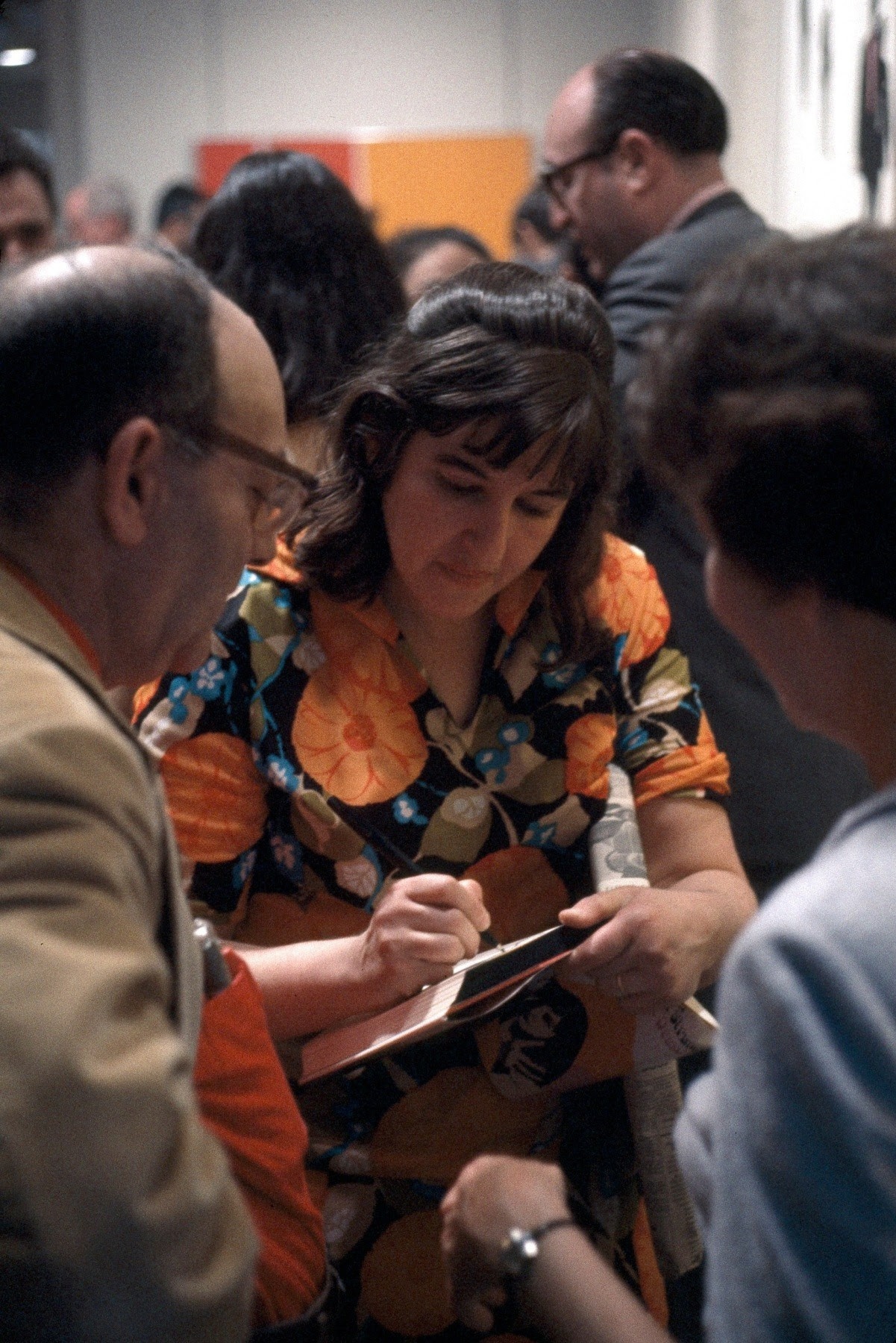
I was not particularly interested in wrestling, I must say. But I was a writer interested in writing. And I was a housekeeper: I didn’t like to waste a thing.
It surprised me, wrestling—it came out of nowhere. I wasn’t the least bit interested in athletics. Sometimes you start something to just challenge yourself. I was working out at Bothner’s Gymnasium on Forty-second Street. There were these
circus people there—a woman who hung upside down from the ceiling with white powder on her face; a guy on a unicycle, cycling around like crazy with his wife upside down on his head; dwarves tumbling and standing on their heads on a mat. And then there were the men, just holding up the sides of the walls, with the reverent silence of men checking women out. I was doing yoga, and another girl there was a professional wrestler. She told me that a man was coming into the city and he could interview me, if I was interested in being a wrestler, too. I thought, Why not?
The interview was me walking back and forth in front of him in a hotel room wearing a bathing suit. Then the man asked me if it would be alright with my husband. That startled me. I told him I’d never asked Sherman’s permission for anything. He said they’d call me in a couple weeks when there was an opening among the girls, meaning someone was injured and couldn’t wrestle. In my case, one of the girls was in a car accident, so they needed me to fill in.
I got the call to go down to Florida. When I walked into a hotel room to meet the other girls, they were doing all sorts of things to their bodies—removing blackheads from the back of their legs, picking bone fragments out of their skin. There was a holy silence in the room as they worked, making each other look very beautiful for the next bout. I did my usual thing of observing, and then, when they pretended to finally notice me, they said I would have to go down to the gym to take a test. They tried me out against another girl, who was tough. I said to myself, I don’t give a damn who’s tough and who’s not. I let her do her deal, all her fancy holds, and I didn’t care one way or another who won. All the girls were tough: waitresses, athletes of all kinds, poor girls trying to get rich.
I picked it up fast. People came in droves to see their favorite wrestlers. At my first match, the crowd was very excited, yelling my name. I entered from beneath the floor, where the dressing rooms were, up into the ring. I was supposed to be the babyface, learning new holds, and taking it all in, and eventually retaliating. The crowd wanted me to destroy the other girl. It was just about responding to the crowd, doing the holds I had just learned.
Andy Warhol made a couple paintings of me as a wrestler. He’d wanted me to star in one of his movies, Kitchen (1966), which would have involved me being murdered, so I had to decline.
I grew up in the Bronx, not far from Van Cortlandt Park, which is so big it felt like its own country then. I didn’t go into Manhattan often until I attended the High School of Music and Art, years later, though I remember visiting the Metropolitan Museum of Art with my father and seeing a Jean Siméon Chardin painting of a peach, which impressed me because it looked so juicy, so perfect. That was something to aspire to—a representation of a peach so real it made you feel like you were part of the painting. I would paint and draw when I was sick in bed, because my mother would bring me all sorts of coloring books and crayons to pass the time. I loved the bold outlines and bright colors of those books. The Crayolas smelled like spring to me.
When I was small, one of my teachers noticed that I was a talented writer, and she had me write little stories about our class trips. My mother offered to be my secretary, so sometimes we’d go to the park together and I would dictate and she would write the stories down. My parents used to argue a lot behind closed doors. Once, in my poor childish handwriting, I wrote down every awful threat and insult. The next morning at breakfast, I handed the paper to my father, who tore it up and threw it down the dumbwaiter. But it showed me the strength of the written word. It has an effect, even if it’s not the desired one.
I married my husband, Sherman Drexler, in 1945, when I was nineteen, and had my first child at twenty; my education in art started around that time. Sherman and I went to museums together and we would talk about what we had seen. Sherman had studied to be an artist, a figurative painter. A few years after we married, we moved to Berkeley, where Sherman was teaching. I had visited museums in San Francisco and New York and I thought, Anyone can make a museum, so I’ll make my own. I arranged found objects, statues, and small collages all over our house. In 1954, Sherman and I had a show together at the Courtyard Gallery in Berkeley; it was my first.
While we were living in California, I bought my first car and took my daughter everywhere. Allen Ginsberg and Peter Orlovsky visited us while we were in Berkeley. They were very tender with each other. I had written some poems and Ginsberg took a look at them and said, “Rosalyn, I don’t mean to hurt you, but you’re not a poet.” Of course I wasn’t. And I hadn’t been on the road with Jack Kerouac; I had been on the road with my five-year-old daughter.
I always had a place to paint and write in my house. Early on, I hung my work in the hall. I used any space I could. I could isolate my mind and be nowhere else except for in front of the work, which I became completely absorbed in. Nobody bothered me. I was lucky. That’s how it went. I never had a real studio—it never occurred to me that I should have one. So many of my friends had studios, but they were all the important artists. I never gave it a thought, I was so happy with my own work and my own things.
I got my first show in New York when the art dealer Ivan Karp introduced me to Anita Reuben, who had opened a gallery in her own name. I was making sculptures at the time with plaster and found objects. In any case, I thought I had to paint in order to continue my career as an artist, and I didn’t know the first thing about drawing or painting. I told myself that if I knew how to work with found objects, I could find images the same way and simply paint over them and that would help me learn how to paint. It was naive, but it worked—my paintings grew larger and I found my place. I was painting over commercial advertising collages clipped from magazines and posters, newspapers and books. My choices weren’t necessarily about intellectual attachment as much as whether there was compelling activity that would look good on a canvas. If it spoke to me, I would pin it down and embalm it with paint so it could never escape me.
I always felt very free, almost on my own, even though I had children. I liked being a mother and cooking and bringing the wash home, when it’s all clean and smells nice. I enjoyed my kids.
All of my friends were feminists. My politics were what we all felt—it was obvious women were being held back. You could hope for a career if you persisted and worked and kept knocking on doors and going out with your portfolios, but still, men were regarded as real artists and women, maybe just painters. I did my feminism by revealing where sexism lifted its ugly head. I wrote an article about “Women Choose Women,” a big show (at The New York Cultural Center, 1978), and all the people who were in it, and neglected to mention that I was one of them. That wasn’t a very clever thing to do.
Much later, a friend introduced me to someone who worked in publishing. He read a paragraph of mine somewhere and had liked it, so he asked if I’d write a novel for him. I agreed, and I figured it out on the way. I called it I Am the Beautiful Stranger. My friend really liked it, and the book sold like hotcakes. It even got good reviews. I figured I should write another book, and I did. To Smithereens was my third book; The New York Review of Books editor compared me to this and that, and then, at the end of his review, wrote, “Why despair of literature?” I had read Honoré de Balzac, D.H. Lawrence, Henry Miller, and Stendhal, but I never aimed to produce a work that someone like him might regard as literature.
What’s important in writing is honesty. You never know when it might mean something to someone else. I was in Paris, not long after I Am the Beautiful Stranger came out, and I received a letter from the beat poet Gregory Corso at the Madison Hotel, thanking me for the book. He called it “honest and compelling” and said it reminded him of the time he was incarcerated. I’m not sure how I managed that, but his words meant more to me than selling copies. You can’t turn your back on encouragement unless you have problems with motivation, which I’ve never had.
Rosalyn Drexler, 2024