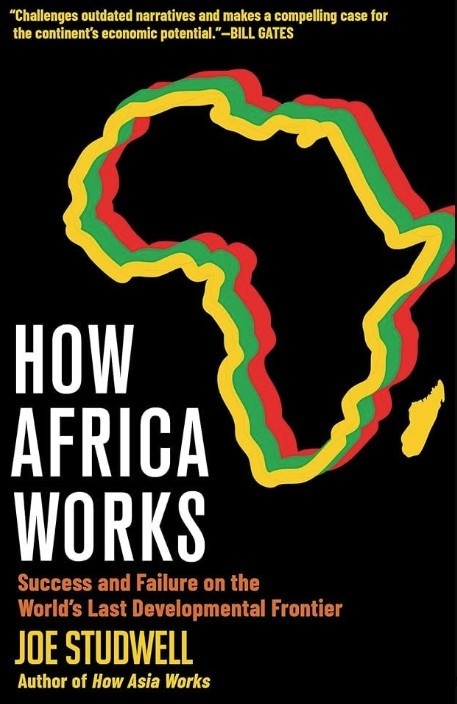
Joe Studwell’s How Africa Works offers a provocative and wide-ranging contribution to contemporary debates on African development, revisiting long-standing explanations while advancing a bold new thesis. As summarized in a recent review Studwell situates Africa’s persistent poverty partly in the legacy of “low-budget colonialism”—extractive rule, weak educational investment, and arbitrarily drawn borders. Yet his more original claim centers on demography: unlike Asia, which industrialized under conditions of high population density and land scarcity, much of Africa remained sparsely populated well into the late twentieth century due to disease, slavery, ecological constraints, and weak agricultural productivity.
For Studwell, only when population density reaches a critical mass can markets deepen, specialization expand, and structural transformation accelerate. In this sense, Africa’s demographic surge may represent not a burden but a delayed precondition for sustained growth. The book is also a comparative sequel to Studwell’s earlier How Asia Works (2013), and he explicitly tests whether Asia’s development “recipe”—productive smallholder agriculture, export-oriented manufacturing, and disciplined state intervention in finance—can be adapted to African realities. Case studies such as Botswana, Rwanda, Mauritius, and Ethiopia illustrate what he calls “developmental coalitions” capable of transcending ethnic fragmentation and prioritizing long-term economic strategy. Reviewers have noted that this framing echoes recent scholarship, including Stefan Dercon’s emphasis on elite bargains and political commitment to growth.
Studwell’s strength lies in synthesizing economic history, political economy, and on-the-ground observation into an accessible yet analytically sharp narrative that challenges both Afro-pessimism and simplistic resource-curse explanations. At the same time, critics question whether population density is as decisive a variable as Studwell suggests. Empirical correlations between density and GDP per capita are uneven, and some of Africa’s most densely populated countries remain poor. Others argue that governance quality, education, fertility transitions, and global economic structures may weigh more heavily than demography alone. Moreover, the transposition of the East Asian model to Africa raises questions about geopolitical context, industrial timing, and global trade regimes.
Nevertheless, How Africa Works succeeds in reframing the conversation: it treats Africa not as a perpetual exception but as a continent potentially entering a structural turning point. For scholars, policymakers, and students of development political economy, the book is both stimulating and deliberately unsettling—precisely the qualities that make it a valuable intervention in current debates on Africa’s economic future.