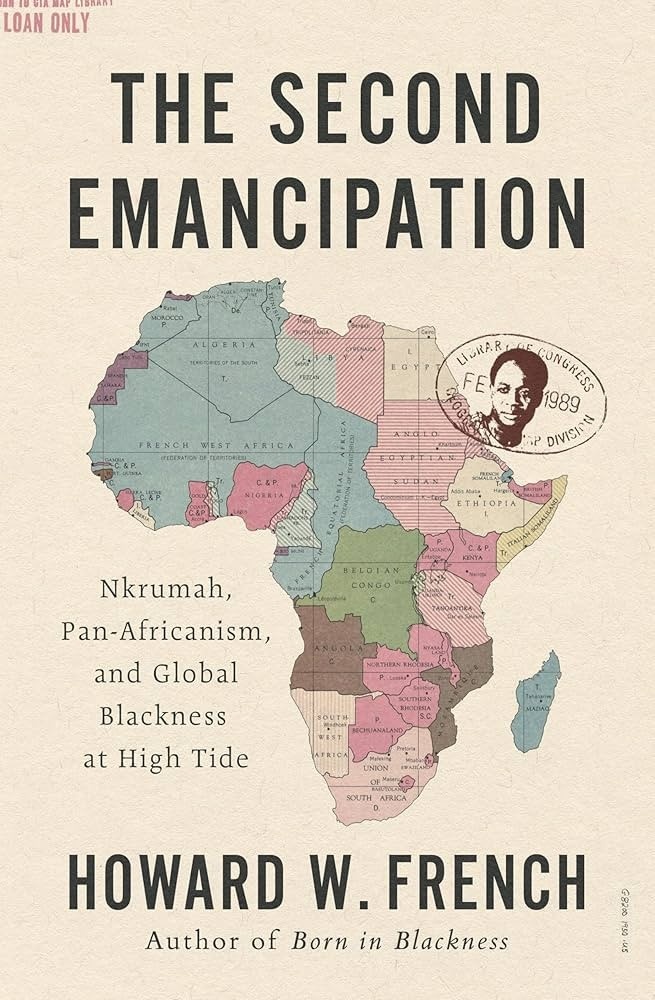
Howard W. French’s The Second Emancipation: Nkrumah, Pan Africanism, and Global Blackness at High Tide repositions Kwame Nkrumah not merely as Ghana’s symbolic liberator, but as a driving ideological force behind an electrifying moment when newly independent African states and the Civil Rights Movement in the U.S. converged in a shared vision for global Black freedom.
French charts Nkrumah’s remarkable journey—from his humble beginnings in the Gold Coast to his transformative years studying in the U.S. and Europe—where he absorbed ideas from thinkers like Du Bois, Fanon, and C.L.R. James. This set the intellectual groundwork for his unwavering stance on Pan African unity and African sovereignty. French paints a vivid picture of a dynamic Harlem, the political ferment of wartime Britain, and the fervor of mass anti-colonial mobilization, illuminating how Nkrumah harnessed these influences to win elections (even from prison) and steer Ghana to independence in 1957—sparked by what French rightly calls “a movement of global Blackness”.
In the second half, French evaluates how Nkrumah’s audacious project collided with Cold War forces and internal contradictions. His ambitious socialist and Pan African agenda placed him uneasily between the U.S. and USSR, at times edging him toward authoritarianism—marked by the purging of dissenters and increasing paranoia. French navigates this tension masterfully, portraying how the regime’s internal fracturing, and Western interference, led to Nkrumah’s 1966 overthrow and his exile. Yet, French refuses to simply mourn a fallen hero; instead, he positions Nkrumah’s vision as a generational legacy—recognizing both its bold aspirations and its unfulfilled promise.
The Second Emancipation emerges as an intellectually rigorous, beautifully written testament to a man and moment that profoundly reshaped modern history—and whose reverberations continue to shape debates over Pan African unity and Black global identity.