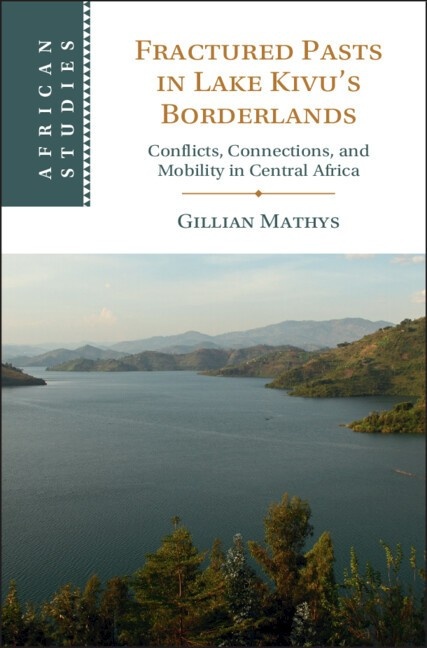
Gillian Mathys’s Fractured pasts in Lake Kivu’s borderlands is a rich and methodologically innovative contribution to the study of conflict in Central Africa. Moving beyond dominant resource-centric explanations of violence in the eastern Democratic Republic of Congo, Mathys reconstructs a longue durée history of the Lake Kivu region that foregrounds mobility, cross-border connections, and social entanglements. The book challenges reductionist narratives that portray the region solely through chronic violence, instead revealing a complex social fabric shaped by trade, migration, and inter-community relations since pre-colonial times. This broader historical lens allows Mathys to reposition conflict not as an inevitable outcome of ethnic or resource competition, but as a contingent process embedded in shifting political and symbolic struggles.
A central strength of the book lies in its critical engagement with historical narratives and their political instrumentalization. Mathys demonstrates how competing and often ideologically driven interpretations—such as the “Greater Rwanda” thesis or notions of autochthony—have been mobilized to justify exclusion, territorial claims, and violence. By dismantling these narratives and tracing their roots across pre-colonial, colonial, and post-independence periods, she shows that “memory and history have become battlegrounds” in the Kivu region. This insight is particularly valuable for both scholars and policymakers, as it underscores the importance of historically grounded analysis in peacebuilding efforts. The book thus contributes to a growing literature that links historiography to conflict resolution, emphasizing that distorted pasts can actively fuel present-day instability.
Methodologically, Mathys adopts a “view from the margins,” combining oral histories with archival research and contemporary discourses to challenge elite-dominated narratives. This approach reveals the fluidity of borders and identities in the Lake Kivu region, where mobility has historically functioned as an economic and social resource rather than a source of division. Her detailed examination of Kinyarwanda-speaking communities further complicates simplistic categorizations of belonging, demonstrating their long-standing and diverse presence in the region.
Overall, the book’s major contribution lies in its reconceptualization of the Great Lakes region as a space of enduring interconnectedness. By highlighting these “undissolvable entanglements,” Mathys offers not only a corrective to dominant conflict narratives but also a more constructive foundation for imagining sustainable peace in Central Africa.