͏‌ ͏‌ ͏‌ ͏‌ ͏‌ ͏‌ ͏‌ ͏‌ ͏‌ ͏‌ ͏‌ ͏‌ ͏‌ ͏‌ ͏‌ ͏‌ ͏‌ ͏‌ ͏‌ ͏‌ ͏‌ ͏‌ ͏‌ ͏‌ ͏‌ ͏‌ ͏‌ ͏‌ ͏‌ ͏‌ ͏‌ ͏‌ ͏‌ ͏‌ ͏‌ ͏‌ ͏‌ ͏‌ ͏‌ ͏‌ ͏‌ ͏‌ ͏‌ ͏‌ ͏‌ ͏‌ ͏‌ ͏‌ ͏‌ ͏‌ ͏‌ ͏‌ ͏‌ ͏‌ ͏‌ ͏‌ ͏‌ ͏‌ ͏‌ ͏‌ ͏‌ ͏‌ ͏‌ ͏‌ ͏‌ ͏‌ ͏‌ ͏‌ ͏‌ ͏‌ ͏‌ ͏‌ ͏‌ ͏‌ ͏‌ ͏‌ 
Is this email not displaying correctly? View it in your browser.
Logo
Image description

Chapala Birders Newsletter - March 2026

eBird Community News & Sightings

Sightings Last Month by Duncan Poole

There were 222 species reported this month for the lake area. The complete list is shown at the end of this newsletter.  Interesting species sighted:

  • Eared Quetzal - Kate and Carl Anderson and Gerry Bird

  • Gray-breasted Martin - Scott Marsh

  • Coppery-tailed Trogon - Kate and Carl Anderson

Correction for last month's Feature Birds: "Birds of Lago Chapala Shoreline".  

Under Long-Billed Dowitchers it should have read: "The Long-billed Dowitchers [LBDO] forage in flocks in the shallow, flooded edges of the lake. They are primarily tactile foragers, probing the substrate and catching prey with the flexible tips of their long, highly enervated bills (See photograph.) Like the Least Sandpipers, they breed in the high Arctic and visit Chapala in the winter months."


Thank you for the Donations💸💰

As a volunteer organization that charges no membership fees and is open to everyone, we are extremely grateful for all donations to cover the costs of the Website hosting and the newsletter. Many thanks go to the following for their recent donations, and especially the very generous donation from Bill Horton! Thank you Kate & Carl Anderson, Gerry Bird, Vivian, Kitty, Bill Horton, Cheshta & Sudas, Gerd & June DeBeer, Barbara Hogan, Duncan Poole, Jules Evens, John Roynon, Bob & Mugs McConnell, Cheryl & Fred. If I missed anyone, or you wish to donate, please send an email to [email protected] We are very grateful and want to acknowledge you! 


Birding Trip Leaders Wanted!🐦

We are a small group of volunteers who work together to share these outings with you. If you would like to help us lead some trips, we will help train you! We always have knowledgeable birders assisting on every trip. Please contact Cheshta at [email protected] if you are interested.


Birding Ethics

Are you familiar with the ethics of birding? If not, learn more here!  Be sure to read our monthly Birding Ethics Tips in this newsletter.

Feature Article: Is Water Hyacinth Bird Habitat? 

by Jules Evens

icon

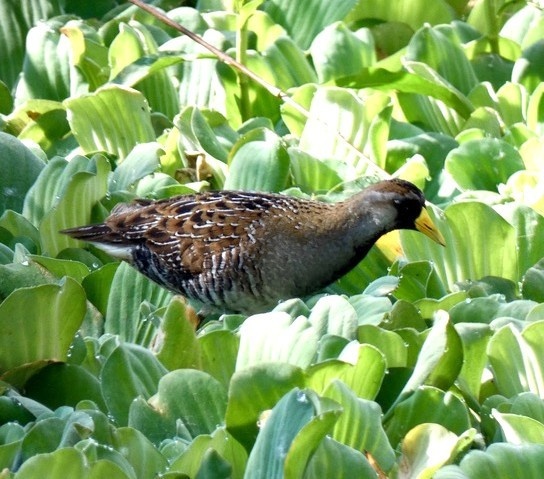
Sora foraging amidst Lirio aquatico Water Hyacinth), San Antonio malecón.


Working as a wetland ecologist, I have witnessed the destructive effects of invasive, non-native plants in various areas throughout the Americas. Lake Chapala is not immune from this threat.


Water hyacinth (Lirio aquatica) is a free-floating perennial plant, native to South America that thrives in fresh water where excessive nutrients pollute waterways. Its attractive purple flowers appeal to may people so it has been added as a decorative feature to many garden ponds. However, it has "escaped" and invaded many bodies of water such as Lake Chapala.


Although some species of birds forage amidst these Lirio infestations, overall it has a long-term negative ecological effect on wetland function and productivity. It colonizes shorelines aggressively, out-competes and excludes other native wetland plants. It grows in dense floating mats, blocks sunlight and reduces oxygen levels in the water, depriving invertebrates, fish and native plants

of sustenance. This causes a cascading effect over time, weakening or even destroying the natural food chains. This decrease in aquatic biodiversity, in turn, affects the livelihoods of fisher folks, limiting the reproductive success of fish and limiting the extent of open water where they can cast their nets. Lirio is also a breeding ground for mosquitoes, which are vectors of diseases (e.g. Dengue fever). 


Lirio infestations also reduce water levels. Their rate of transpiration (water lost through the leaves) is up to three times greater than natural evaporation on an uncovered water surface.


Control of Lirio has been attempted at many bodies of water around Jalisco and central Mexico, but these efforts are very labor intensive, expensive, can cause extensive disturbance to the underlying soil, and the effects tend to be temporary.


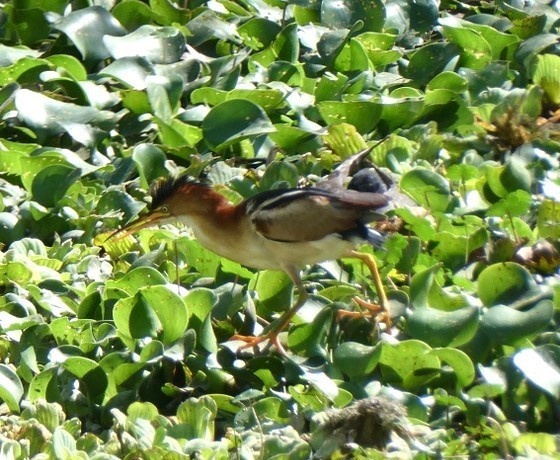
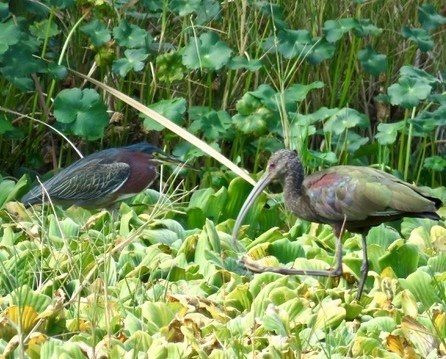
I recorded the following species foraging in Lirio along the lakeshore while considering this article: Snowy Egret, Great Egret, Least Bittern, White-faced Ibis, Sora, Northern Jacana, Stripe-headed Sparrow, Greater Kiskadee, Common Gallinule, Great-tailed Grackle, Cinnamon-rumped Seedeater. But such diversity may be short-lived as the effects of the Lirio invasion evolve over time and the productivity of the shoreline is diminished. Also, as conversion of the wetland from a diverse native plant community to a Lirio monoculture progresses, the availability of the viable habitat on which some of the rarer birds that have inhabited these shores—Least Bittern, Aztec Rail, Marsh Wren, Chapala Yellowthroat—is lost and these species disappear.

      All photos by Jules Evens.

Image description

Least Bittern actively foraging in Lirio, Riberas Marsh.

Image description

Green Heron (L) & White-faced Ibis (R) in Lirio, San Antonio Tlayacapan.

Tip #8 for Birding Ethics

If while birding you come across a species that is unusual for the area, it is wise to document the bird information as thoroughly as possible. This practice will help ensure the bird is identified correctly, and if not, the correct species can be identified. Include if possible:

  • digital images, including "digiscoped" images taken through binoculars or spotting scopes

  • audio recordings of songs, calls or flight calls

  • videos that help establish identification, especially to show behaviors

  • detailed field notes explaining what was observed, how many others saw it, where it was seen, what kind of habitat, etc.

Learn more here about Birding Ethics.

Upcoming Bird Trips

Our bird-walks are open to all those interested in birds; beginners & experienced birders. We always have knowledgeable birders on hand to identify the species. We have a limited number of extra binoculars available upon request in advance of trip.

————

During these outings social conversations are limited so we do not scare the birds we are observing. Birders can gather for coffee or a meal to socialize later.

————

We try to limit most car trips to 3-4 vehicles / 12-16 people. Larger convoys are hard to manage. If you are being given a ride, you are expected make a contribution to your driver for gas and tolls ($200 - $400 pesos based on length of trip).

1st SUNDAY OF THE MONTH: March 1st there will be a birding outing along the Allen Lloyd Trail. Meet up with team leader Duncan Poole at 8am at the trailhead. Expect to see Blue Mockingbird, Happy Wren, and maybe a Russet-crowned Motmot or Squirrel Cuckoo. Please confirm your attendance by sending an email to [email protected] or just show up.

How to get to the trail head: Drive up the Libramiento a half mile (1 km) from the traffic light at Walmart, then turn left (carefully) as you would for the hospital (Ribera Medical Center). Double back and drive up the left side of the hospital. Keep going uphill another half mile, and park on the only street to your left. Here is a pindrop.


On Monday, March 16th, meet team leader Jules Evens at 8.00 am at the San Antonio Malecón parking lot to walk the Malecón area. At about 9.30-10.00am we will do the list and then those who wish to can gather together at a restaurant for breakfast. Please confirm your attendance at least 2 days in advance with Jules at [email protected]. Here is a pindrop for the Malecón. 

How to get to the parking lot: In San Antonio Tlayacapan along the Carretera, turn toward the lake on Colón and drive to the end of the street to the parking lot. (see pindrop).


On Tuesday March 24 meet up with team leader Robert McConnell at 8:00 am at the “Sculpture” (at the only traffic light in La Floresta, south-east corner near Restaurant Pranzo. See pindrop, departing immediately for Villa Corona on Lake Atotonilco (60 minutes drive). We expect to see various shore birds such as White-faced Ibis and Roseate Spoonbill. Bring your own mid-morning refreshments. There will be a break for snacking at about 11.00 am. We will be back in Ajijic by about 1.30 pm.  Please confirm your attendance at least 5 days in advance. Email [email protected] and indicate if you wish to be a passenger or if you can bring a vehicle and take others. Trip will be limited to 3 cars, 12 participants. Each passenger is expected to donate to their driver $200 pesos to share the travel expenses.

Bird Trip Summaries: February by Trip Leaders

On Sunday, February 1st, Kate and Carl Anderson had a great group of 11 to begin our walk up the Allen Lloyd canyon in which many wonderful birds were seen. Tom got us all on the tiny hummingbird flitting around a flowering tree. Diego was able to ID it since he had seen one in the Tepalo waterfall trail recently outside of Ajijic - a Calliope Hummingbird female. So tiny! A special migrant in the area. Other sightings include a lot of Varied Bunting, Blue Mockingbird, Golden Vireo, Groove-billed Ani and 2 Mexican Squirrel Cuckoo. An American Kestrel caught and ate a huge green katydid on the top of a pole near us. Visitors Linda and Roger from Renton, Washington commented on how cool it is for us to have this Chapala Birders group. They had not seen anything like that in other places in Mexico. For a complete list and photos see https://ebird.org/checklist/S298490664


On Friday, February 6th, 15 people joined Kate and Carl Anderson at Ciénaga Ribera del Pilar (the Riberas marsh) 52 species! We began with a Green heron flying right over us. A Sora wandered along feeding right in front of us for several minutes. This little star had lots of photos taken. A Least bittern was heard. A surprise Lincoln sparrow showed itself. A whole flock of Fulvous Whistling ducks flew over the Marsh. The elusive Marsh wren came out. The Pied bill Grebe pair made an appearance. A beautiful Mexican King snake swam in front of the group. There used to be lots of them but now it is a rarity. Some people got “lifers”! Wonderful morning with neat people.
After we went over the List we all went over to La Reservita where a Zone Tailed hawk flew right over us! Everyone was very excited to see a little bit of land preserved for our feathered friends. A couple of people walked from there down to The Point at the Parke Riberas del Pilar. That is a neat spot where one can see the entire Lake.

La Ciénaga /Riberas Marsh Checklist https://ebird.org/checklist/S301322839

La Reservita Checklist https://ebird.org/checklist/S301322700


On Wednesday, February 18th 10 Lake Chapala birders led by Duncan Poole travelled to the Lake Cajititlán. We recorded 75 species including a pair of Mature Gray Hawks, Red-tailed Hawks, Crested Caracara, Lark flock of feeding Northern Shovelers. A highlight was a herd of horses driven past us by Mexicans on motorcycles.  See ebird for a complete list and images https://ebird.org/checklist/S302039695.

Monthly Sightings 

by Duncan Poole

What is the “Lake Chapala Area” for bird sightings?

We define it as the whole area of the lake plus all land within 15 km (7 miles) from the edge of the lake. We combine sightings for the month from Chapala, Jocotopec, Ixtlahuacán de los Membrillos, Poncitlán, Ocotlán, Jamay, & La Manzanilla de la Paz.


222 species were observed around Lake Chapala in February! (in Taxonomic order):

1      Fulvous Whistling-Duck

2      Blue-winged Teal

3      Cinnamon Teal

4      Northern Shoveler

5      Gadwall

6      American Widgeon

7      Mexican Duck

8      Northern Pintail

9      Green-winged Teal

10    Ruddy Duck

11    Northern Bobwhite

12    Rock Pigeon

13    Eurasian Collared-Dove

14    Inca Dove

15    Common Ground Dove

16    Ruddy Ground Dove

17    White-tipped Dove

18    White-winged Dove

19    Mourning Dove

20    Groove-billed Ani

21    Lesser Roadrunner

22    Greater Roadrunner

23    Mexican Squirrel-Cuckoo

24    Buff-collared Nightjar

25    Mexican Whip-poor-will

26    Mexican Violetear

27    Rivoli's Hummingbird

28    Plain-capped Starthroat

29    Blue-throated Mountain-gem

30    Ruby-throated Hummingbird

31    Black-chinned Hummingbird

32    Calliope Hummingbird

33    Rufous Hummingbird

34    Broad-tailed Hummingbird

35    Broad-billed Hummingbird

36    White-eared Hummingbird

37    Violet-crowned Hummingbird

38    Berylline Hummingbird

39    Sora

40    Common Gallinule

41    American Coot

42    Black-necked Stilt

43    American Avocet

44    Killdeer

45    Northern Jacana

46    Long-billed Dowitcher

47    Wilson's Snipe

48    Spotted Sandpiper

49    Solitary Sandpiper

50    Greater Yellowlegs

51    Least Sandpiper

52    Laughing Gull

53    Ring-billed Gull

54    Caspian Tern

55    Forster's Tern

56    Royal Tern

57    Least Grebe

58    Pied-billed Grebe

59    Western Grebe

60    Clark’s Grebe

61    Wood Stork

62    Neotropic Cormorant

63    White-faced Ibis

64    Least Bittern

65    Black-crowned Night Heron

66    Tricolored Heron

67    Snowy Egret

68    Green Heron

69    Western Cattle-Egret

70    Great Egret

71    Great Blue Heron

72    American White Pelican

73    Black Vulture

74    Turkey Vulture

75    Osprey

76    White-tailed Kite

77    Sharp-shinned Hawk

78    Cooper's Hawk

79    Northern Harrier

80    Gray Hawk

81    Zone-tailed Hawk

82    Short-tailed Hawk

83    Red-tailed Hawk

84    Western Screech-Owl

85    Great Horned Owl

86    Northern Pygmy-Owl

87    Ferruginous Pygmy-Owl

88    Mottled Owl

89    Spotted Owl

90    Coppery-tailed Trogon

91    Eared Quetzal

92    Russet-crowned Motmot

93    Belted Kingfisher

94    Yellow-bellied Sapsucker

95    Red-naped Sapsucker

96    Acorn Woodpecker

97    Gila Woodpecker

98    Golden-fronted Woodpecker

99    Ladder-backed Woodpecker

100  Hairy Woodpecker

101  Crested Caracara

102  American Kestrel

103  Merlin

104  Monk Parakeet

105  Military Macaw

106  White-striped Woodcreeper

107  Rose-throated Becard

108  Northern Beardless-Tyrannulet

109  Greenish Elaenia

110  Tufted Flycatcher

111  Greater Pewee

112  Least Flycatcher

113  Hammond's Flycatcher

114  Dusky Flycatcher

115  Western Flycatcher

116  Black Phoebe

117  Say’s Phoebe

118  Vermilion Flycatcher

119  Dusky-capped Flycatcher

120  Ash-throated Flycatcher

121  Nutting's Flycatcher

122  Brown-crested Flycatcher

123  Great Kiskadee

124  Social Flycatcher

125  Tropical Kingbird

126  Cassin's Kingbird

127  Thick-billed Kingbird

128  Western Kingbird

129  Golden Vireo

130  Black-capped Vireo

131  Bell’s Vireo

132  Hutton's Vireo

133  Cassin's Vireo

134  Plumbeous Vireo

135  Western Warbling Vireo

136  Loggerhead Shrike

137  Common Raven

138  Tree Swallow

139  Gray-breasted Martin

140  Northern Rough-winged Swallow

141  Barn Swallow

142  Bushtit

143  Ruby-crowned Kinglet

144  Blue-gray Gnatcatcher

145  Canyon Wren

146  Northern House Wren

147  Marsh Wren

148  Bewick's Wren

149  Spotted Wren

150  Happy Wren

151  Sinaloa Wren

152  Blue Mockingbird

153  Curve-billed Thrasher

154  Northern Mockingbird

155  Brown-backed Solitaire

156  Orange-billed Nightingale-Thrush

157  Hermit Thrush

158  American Robin

159  Rufous-backed Robin

160  Cedar Waxwing

161  Gray Silky-flycatcher

162  House Sparrow

163  American Pipit

164  Elegant Euphonia

165  House Finch

166  Lesser Goldfinch

167  Stripe-headed Sparrow

168  Chipping Sparrow

169  Clay-colored Sparrow

170  Brewer's Sparrow

171  Lark Sparrow

172  White-crowned Sparrow

173  Savannah Sparrow

174  Lincoln's Sparrow

175  Rusty-crowned Ground-Sparrow

176  Canyon Towhee

177  Rusty Sparrow

178  Rufous-crowned Sparrow

179  Green-tailed Towhee

180  Rufous-capped Brushfinch

181  Yellow-breasted Chat

182  Yellow-headed Blackbird

183  Black-vented Oriole

184  Orchard Oriole

185  Hooded Oriole

186  Streak-backed Oriole

187  Bullock's Oriole

188  Black-backed Oriole

189  Red-winged Blackbird

190  Bronzed Cowbird

191  Brown-headed Cowbird

192  Brewer's Blackbird

193  Great-tailed Grackle

194  Northern Waterthrush

195  Black-and-white Warbler

196  Orange-crowned Warbler

197  Lucy's Warbler

198  Nashville Warbler

199  Virginia's Warbler

200  MacGillivray's Warbler

201  Common Yellowthroat

202  American Redstart

203  Northern Yellow Warbler

204  Yellow-rumped Warbler

205  Black-throated Gray Warbler

206  Townsend’s Warbler

207  Hermit Warbler

208  Rufous-capped Warbler

209  Wilson's Warbler

210  Red-faced Warbler

211  Painted Redstart

212  Hepatic Tanager

213  Summer Tanager

214  Western Tanager

215  Flame-colored Tanager

216  Black-headed Grosbeak

217  Blue Grosbeak

218  Lazuli Bunting

219  Indigo Bunting

220  Varied Bunting

221  Painted Bunting

222  Cinnamon-rumped Seedeater

John and Rosemary Keeling

John and Rosemary Keeling

Lake Chapala Birders is an informal group of bird observers led by a team of Chapala Birders on behalf of John & Rosemary Keeling.


Overall Coordinator: Cheshta Buckley

Newsletter: Mugs McConnell

Website: Robert McConnell

Feature Bird: Jules Evens

Monthly Sightings List: Duncan Poole

Bird Trip Leaders & Reports: Cheshta Buckley, Thomas Bravo, Kate & Carl Anderson, Jules Evens, Duncan Poole, John Roynon, Robert Taylor, Robert McConnell.

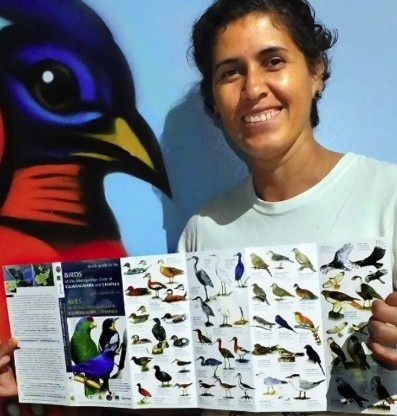
Illustrated color folders showing our common birds are available for $200 pesos from your birding group leaders on bird walks. Also available at Diane Pearl’s Gallery, 11am to 4pm, Santa Margarita #23, Riberas del Pilar.


You can sign up for this newsletter or send us your exciting bird sightings to [email protected]


Check our website: ChapalaBirders.org  There you will find our newsletters, illustrations of our birds and advice on buying binoculars, books & birding apps.

Image description
Image description

Copyright (C) 2026, Lake Chapala Birders. All rights reserved.
Our mailing address is: Calle Santa Isabel #32, Riberas del Pilar (Ajijic), Chapala, JA, 45906 MX

To sign up for this newsletter, email [email protected]

If you would like to unsubscribe, please click here.
Powered by Sender.net