͏‌ ͏‌ ͏‌ ͏‌ ͏‌ ͏‌ ͏‌ ͏‌ ͏‌ ͏‌ ͏‌ ͏‌ ͏‌ ͏‌ ͏‌ ͏‌ ͏‌ ͏‌ ͏‌ ͏‌ ͏‌ ͏‌ ͏‌ ͏‌ ͏‌ ͏‌ ͏‌ ͏‌ ͏‌ ͏‌ ͏‌ ͏‌ ͏‌ ͏‌ ͏‌ ͏‌ ͏‌ ͏‌ ͏‌ ͏‌ ͏‌ ͏‌ ͏‌ ͏‌ ͏‌ ͏‌ ͏‌ ͏‌ ͏‌ ͏‌ ͏‌ ͏‌ ͏‌ ͏‌ ͏‌ ͏‌ ͏‌ ͏‌ ͏‌ ͏‌ ͏‌ ͏‌ ͏‌ ͏‌ ͏‌ ͏‌ ͏‌ ͏‌ ͏‌ ͏‌ ͏‌ ͏‌ ͏‌ ͏‌ ͏‌ ͏‌ 
Is this email not displaying correctly? View it in your browser.
Image description
Image description

                           Demeter Newsletter -- March 2025


Greetings from Demeter!

In this issue:  
+ Certification News: It's Certification Renewal Season!

+ Feature: Damya Olive Oil

+ Soil Monitoring Protocol

+ Standards Feature: Transitioning to Biodynamic

+ Research: Silicon applications; Literature Review

+ Staff Corner: 2025 Inspector Trainings


Please send newsletter content suggestions or questions to:   [email protected]


Certification News


2025 Renewal Emails were sent out on March 7th!


If you did not see an email from Demeter on the 7th of March, requesting renewal documentation for the 2025 certification cycle, please let the office know so that we can make sure you receive it.


The renewal email includes links to the Terms of Agreement contract, the 2025 Update Form, and any others required for your certification category.  


Please return these forms to us by April 1st.  A late fee will be assesed for any forms received after this deadline.


Once these forms are returned, we will email you an invoice for your yearly renewal and licensing fees. Farms and Processors will receive their certificates upon payment, and will soon hear from one of our inspectors regarding their annual inspection. Traders will receive an email requesting information to allow the completion of a desk audit that enables us to update our records and confirm product traceability, in order to issue 2025 certificates.


We look forward to working with you!


Questions about certification?  

Please contact Sarah: [email protected].


Calling all 

Photographers!

Image description

Demeter would love to feature your photos, with full credit, on our website, newseltter, social media, brochures, etc.  Our partner organization BFDI (Biodynamic Federation Demeter International) is also seeking high resolution photos.   If you would be willing to share some nice shots of your farm, products, or facilities, we'd love to put them to good use in spreading the word about Biodynamic Agriculture!  Please email high resolution images to: [email protected].


Notes from the Field...

We are reserving a spot in each of our newsletters to feature a farmer or other certified business owner. If you'd like to write a brief article about your experience with Biodynamic Production, Processing, or Marketing, or answer some interview questions about your operation, we'd love to share it with our readers!


Please contact Nell at [email protected] for more details.


Image description

Farm Feature 

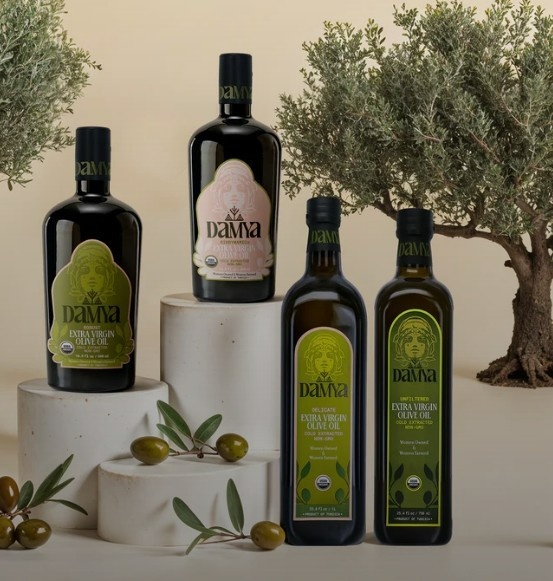
Damya Biodynamic® Olive Oil


For this month’s newsletter, we were fortunate to have the chance to interview Demeter-certified Trader Naouel Bouabid, whose company Massiva brings her award-winning Damya-brand olive oil to the United States.


Naouel answered questions over email, describing her family’s farm in Tunisia, their embrace of Biodynamic production methods, and her experience importing their products to the U.S., after moving here in 2017.


Can you provide some background on your family’s farm in Tunisia?  Do you raise other crops in addition to olives?  For how long has it been Demeter certified?   When did you begin importing olive oils to the United States?

Our family's farm in the Tunisian Sahal region has a long history of growing Tunisian olive varieties and almonds. We also cultivate prickly pears and fig trees along the edges of our land, which helps create a diverse ecosystem. We've been practicing Biodynamic farming and have held Demeter certification for 8 years, showing our dedication to sustainability and quality.


We recognized the unique qualities of our olive oil and decided to share it with the U.S. market, beginning imports in 2020. It's been a rewarding experience to introduce our traditional Tunisian olive oil to American consumers.


What does the Demeter certification mean to your family as farmers and producers of olive oil?  What shaped the decision to pursue certification?

Demeter certification is a commitment to sustainable, Biodynamic farming practices. It means we're producing olive oil that's not only of the highest quality but also respectful of the environment. We pursued certification because we believe in the interconnectedness of soil, plants, and people, and we wanted to reflect that in our work.


Are there aspects of Biodynamic management that you particularly appreciate and/or believe create a high-quality product?  

We've seen great benefits from both the Biodynamic preparations and the biodiverse plantings. The preparations seem to invigorate the soil and enhance the vitality of our trees, while the diverse plantings create a natural balance that supports the overall health of the farm. We've noticed a significant reduction in pests and diseases, as the diverse plant life attracts beneficial insects and creates a natural balance. This approach contributes to the overall quality and complexity of our olive oil.


Do you feel that your olive oil has had a good reception in the United States?  Do you do any outreach to your customers about Biodynamics?

People in the US love our olive oil, which is great!  However, we've also noticed that many customers aren't yet very familiar with Biodynamic farming practices. We see this as an opportunity to educate and share our passion. We're actively working on creating more educational content, both online and in person, to help people understand the benefits of Biodynamics. We believe that by increasing awareness, we can foster a deeper appreciation for the quality and sustainability of our olive oil.


Damya's olive oil has won awards in the New York International Olive Oil Competition for the last several years, and in 2024 brought home a gold and a silver award.  You can read more about their success in the 2024 competition in this article published in The Olive Oil Times.

Image description

Demeter Establishes a Soil Monitoring Protocol 

for Certified Farms


By Evrett Lunquist, Director of Certification

For around a decade, Demeter inspectors have reported on soil health and biodiversity on certified farms. With this year's certification renewal cycle, Demeter is introducing a complementary Soil Monitoring Protocol for farms (found here on our website) that links this type of reporting to a specific location on a farm to allow revisiting and comparison over time. This protocol continues and refreshes the work Demeter started in 2018 focused on monitoring soil organic matter on certified farms.


It has long been observed that implementing Biodynamic farming practices results in improved soil health, and part of that is maintained or increasing soil organic matter levels. The Demeter Standard requires that “Soil carbon (i.e., humus) levels must be maintained and ideally increased over time.” This Soil Monitoring Protocol allows Demeter to track the soil carbon or organic matter levels and understand soil health over time through the use of eight soil quality assessments, including compaction, hardpan detection, evidence of macro-life, water infiltration, aggregate strength, root growth, soil smell, and percent of ground cover.


What does this mean for farmers? Sometime this year, at a time when the soil is biologically active, farmers will complete the worksheet found in the Protocol and submit a soil sample for lab testing of Soil Organic Matter or Soil Organic Carbon. Complete instructions are found in the Soil Monitoring Protocol linked above. The completed worksheet and soil test report are returned to Demeter for evaluation. Completing the protocol, including soil testing, is required at least once every three years.


While maintaining or increasing soil carbon is required for Demeter certification, determining if this requirement is met is not a simple ‘yes’ or ‘no’ checkbox completed by the inspector. The science of soil carbon measurement is still developing, and carbon/organic matter levels in the soil can fluctuate and change slowly. For this reason, Demeter developed a Guidance Document (linked here) on how the certification side of soil monitoring will occur. There are many practices identified in the Biodynamic Standard that can be implemented or enhanced to ensure soil carbon levels are maintained or increased.


The mission of Demeter is “To enable people to farm successfully, in accordance with Biodynamic® practices and principles.” There is a strong element of education included with the Soil Monitoring Protocol. Each measured indicator includes an interpretation of what it shows about the soil and what it does not show. I have long ascribed to the saying “To manage something, one must understand it.” This protocol is at once a requirement for certification and a tool for better understanding of the soil.


A huge thank you to Dr. Will Brinton, from Woods End Laboratory, for helping us create a simple, approachable, and relevant process, and for bringing forward a strong educational element within the protocol.


Demeter Standards Feature


Links to the Demeter Farm and Processing Standards can be found on our website's home page: Demeter USA Farm and Processing Standards


Transitioning a Farm to Biodynamic Production


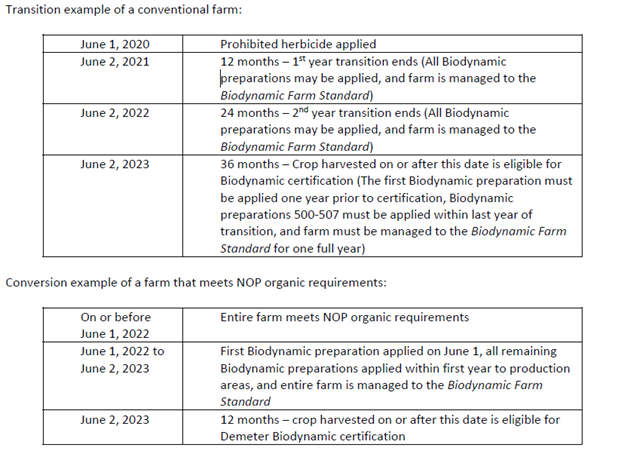
The updated Farm Standard includes charts to assist landowners in understanding the requirements of transitioning land to Biodynamic certification.  These charts include examples of various scenarios, including a farm that is conventional and one that already meats the National Organic Program (NOP) requirements.


Demeter staff can help you determine what steps may be needed to transition your land - don't hesitate to reach out!


From Section VII of the Demeter Farm Standard:


"The land to be certified must meet the National Organic Program (NOP) standard as a base and be managed to the Biodynamic Farm Standard for one year. The one-year conversion to Demeter certification begins with the first Biodynamic preparation application (500, 501 or 502-507 in combination) and may occur concurrently with the final NOP transition year or an additional year after the NOP standard has been met. No prohibited chemicals may have been applied for a full 36 months. Demeter may request residue tests for prohibited materials."

Image description
Image description

- Staff Corner -


Sarah Rhynalds

Certification Manager

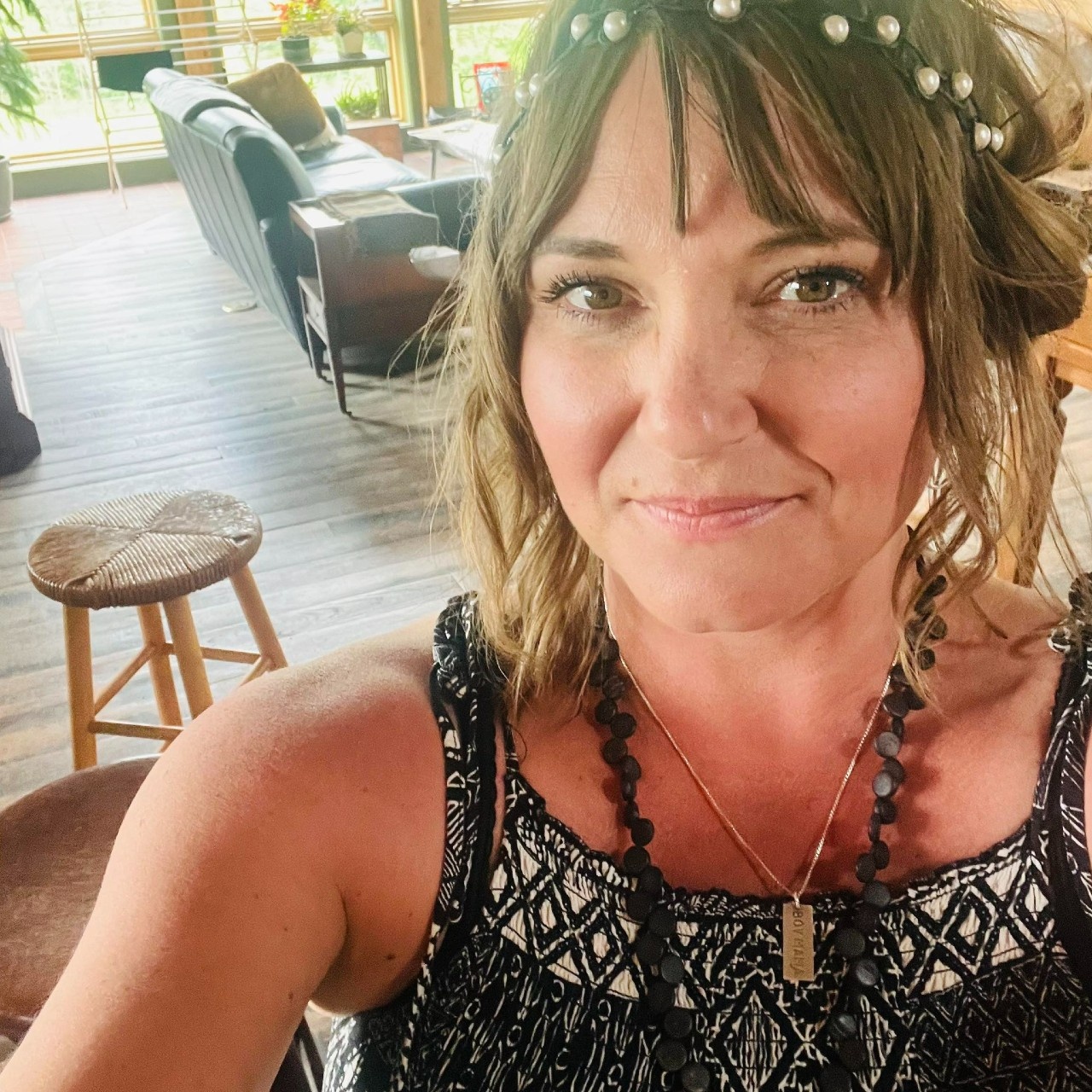
Visiting Churchtown Dairy with Jennie and Jean-David.

2025 Inspector Trainings


A warm and heartfelt greeting from the Certification Manager! 


As is tradition each year in the month of March, we gather virtually for our highly anticipated annual inspector training sessions, hosted with care via Zoom. This process truly begins in the months leading up to the training, where I reach out to all the esteemed organic certification agencies with whom our clients hold certifications, in an effort to extend invitations to new inspectors. The goal, as always, is to recruit fresh faces to join our ranks in performing dual certification inspections.   The core of our mission—to provide a single inspection for our dual-certified clients—remains my number one priority.  This initiative is designed to not only streamline but also ease the time and financial burdens often associated with the certification process,  ultimately benefiting our clients.


It is with immense joy and pride that I share the wonderful news that this year’s training has been the most diverse, successful, and rewarding experience we’ve had to date! We are absolutely thrilled to welcome an impressive array of new inspectors from an inspiring variety of organizations: CCOF, OTCO, NOFA NY, One Cert, OCIA, ECO CERT Canada, and PACS Canada. Our group of dedicated individuals now stretches across the vast expanse of the United States and Canada, making this year’s cohort truly representative of the diversity and spirit of collaboration that drives the organic and Biodynamic movements forward.


This year's Inspector Training featured a solid introduction to Biodynamic farming for inspectors that are joining us for the first time this year.  We held a second training the following week that included our full group of inspectors, and focused on the use of our database system during inspections, to make sure the process goes smoothly, and our inspectors are well prepared for the season.


Each year, my steadfast goal is to bring new energy and perspectives into our community of inspectors, and this year, I can confidently say that we have truly hit the mark. Thanks to the willingness and enthusiasm of these talented individuals to be a part of the broader Biodynamic movement, we’ve seen an outpouring of support and commitment that makes us all incredibly hopeful for the future of certification.

Image description

It's Seed Catalogue Season!

Winter is the time for garden dreams.  Demeter's two certified Biodynamic seed companies carry vegetable, herb, and flower seeds.


Meadowlark Hearth

120024 Everett Drive
Scottsbluff, NE 69361

[email protected]

http://www.meadowlarkhearth.org


Turtle Tree Seed

10 White Birch Road

Copake, NY 12516

[email protected]

http://turtletreeseed.org/


Research Focus


Silicon Benefits Highlighted in 2024 Literature Review


Biodynamic Preparation 501 must be applied at least once per crop cycle to all harvested Biodynamic-certified crops. 501 is the Horn Silica, consisting of ground quartz or other minerals of high silicon dioxide content, mixed with water and placed in a cow horn and buried in the soil from spring to fall, afterward retrieved and stored in a sunny location.  The resulting preparation is stirred in water and sprayed in the early morning hours as a fine mist over plant foliage.


In September of 2024, a Literature Review titled Silicon, An Emergent Strategy to Lighten the Effects of (A) Biotic Stresses on Crops was published in the Journal of Agronomy and Crop Science.  This study examined plant response to the application of Silicon (Si) demonstrated in recent published studies.  Some of the paper’s conclusions, grouped by category, are shown below.


Leaves

+ Improvement to leaf structure

+ Increase of transpiration rate

+ Increase of photosynthetic rates

+ Improvement of water use efficiency

+ Increase in soluble sugars


Root and Soil

+ Improvement in physical and chemical properties of soil

+ Increase in water and nutrient uptake

+ Increase in root mass and density


Biotic and Abiotic Stress

+ Protection against biotic and abiotic stresses increased

+ Increase of defenses against pests and diseases

+ Decrease in heavy metal toxicity

+ Increase in drought tolerance

+ Decrease in salinity stress


Plant Performance

+ Improved germination

+ Improved water use efficiency

+ Improved antioxidant activity

+ Increased total antioxidant capacity and total phenols

+ Increased yields

+ Increased Si concentration

+ Decreased incidence of powdery mildew and brown rot


~ CALENDAR ~


If you'd like your event announced in our monthly newsletter, please send details to: [email protected]

▪▪▪▪▪▪▪▪▪▪▪▪▪▪▪▪▪▪▪▪▪▪▪▪▪▪▪▪▪▪▪▪▪▪▪▪


Biodynamic Beekeeping Basics

April 5th

Spikenard Farm Honeybee Sanctuary, Floyd VA

For details: Biodynamic Beekeeping


▪▪▪▪▪▪▪▪▪▪▪▪▪▪▪▪▪▪▪▪▪▪▪▪▪▪▪▪▪▪▪▪▪▪▪▪


Spring Open House - Oregon Biodynamic Group

April 13th

Montinore Estate, Forest Grove, Oregon

For details: Spring Open House


▪▪▪▪▪▪▪▪▪▪▪▪▪▪▪▪▪▪▪▪▪▪▪▪▪▪▪▪▪▪▪▪▪▪▪▪


Geothaneum Section for Agriculture Online Course

Agri-Culture: Rhythms and Rituals

April 14th

For details: Rhythms and Rituals


▪▪▪▪▪▪▪▪▪▪▪▪▪▪▪▪▪▪▪▪▪▪▪▪▪▪▪▪▪▪▪▪▪▪▪▪


Churchtown Dairy Events

Weekly farm and garden tours, cheese tasting, festivals and more!

For details: Talks, Workshops + Events — Churchtown Dairy


▪▪▪▪▪▪▪▪▪▪▪▪▪▪▪▪▪▪▪▪▪▪▪▪▪▪▪▪▪▪▪▪▪▪▪▪


You can find many more events on the Biodynamic Association's 

Event Calendar

BDA Community Calendar


▪▪▪▪▪▪▪▪▪▪▪▪▪▪▪▪▪▪▪▪▪▪▪▪▪▪▪▪▪▪▪▪▪▪▪▪


Demeter Business Meetings:

Demeter Standard Committee – meets the 2nd and 4th Tuesday of the month


Demeter Board – meets the 3rd Monday of the month

Image description

Demeter Association, Inc.

317 Church Street
Phoenixville, PA 19460


www.demeter-usa.org

Facebook: Demeter USA    Instagram: demeter_usa

If you would like to unsubscribe, please click here.
Powered by Sender.net