Sparkling-tailed Hummingbird
This stunning hummingbird, was formerly named Sparkling-tailed Woodstar and also known as Dupont’s Hummingbird. The species name, dupont, refers to Léonard Dupont (1796-1828), a Parisian trader of exotic natural history specimens, an expert taxidermist, and an erstwhile explorer. The genus name, Tilmatura, translates either as “miraculous coat,” an apt sobriquet given the male’s spectacular plumage, or as “plucked tail.”
Distribution: It occurs in scattered and disjunct locations from Mazatlán through Central America south to Northern Nicaragua. The species is rather uncommon throughout its range. Although considered “non-migratory” it is a summer visitor to the Chapala area, probably dispersing from nesting areas closer to the coast. In Mexico, the Sparkling-tailed Hummingbird is considered a threatened species due to its patchy distribution.
Habitat: Associated with pine-oak forests, brush and thorn scrub, often associated with oaks.
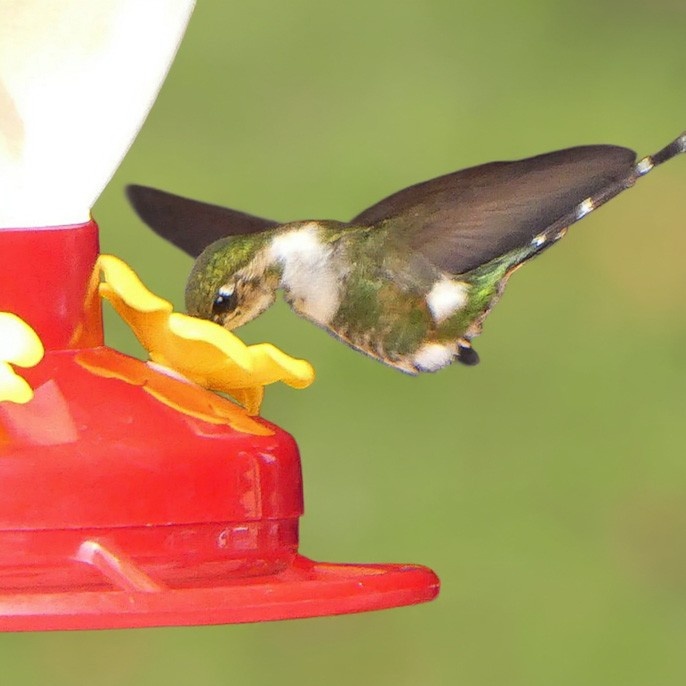
Identification: The male and female are quite distinct from one another. The male sports a sparkling violet-blue gorget bordered below by a white breast band, a greenish belly, and a forked tail with dramatically elongated outer tail feathers broadly tipped white. The female’s tail is much shorter but also white tipped and has a slight notch. Her underparts are uniformly cinnamon extending up through the throat and onto the cheek. Both sexes have distinctive white patches on either side of the rump and rather short straight bills. These two field marks distinguish them from other hummingbirds. These hummers are not very vocal, and there are few available recordings. The male may make a very subtle “high, thin, but musical squeaking” sound from a perch. In flight, the wings produce an “insect-like” hum, similar to a Broad-tailed Hummingbird. The flight is described as “bee-like.”
Behavior: Like most other hummingbirds, it is nectivorous, visits feeders, and sallies out for flying insects. The Sparkling-tailed is presumed to be polygynous, that is the males may mate with several females, also a common hummingbird behavior.
Breeding display: As described, the female may be perched on a branch as the male displays in the air in front of her, flying back-and-forth, fanning his spectacular tail feathers and flashing his iridescent throat (gorget).