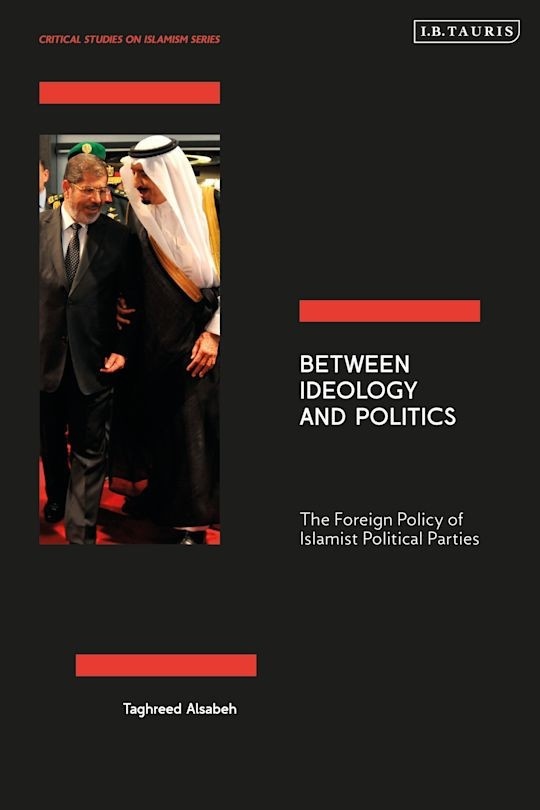
Taghreed Alsabeh’s Between Ideology and Politics: The Foreign Policy of Islamist Political Parties offers a carefully structured comparative analysis of Islamist parties in power across North Africa, focusing on Egypt’s Freedom and Justice Party, Morocco’s Justice and Development Party, and Tunisia’s Ennahda. The book intervenes in a debate that initially assumed that Islamist electoral victories after the Arab Spring would translate into ideologically driven foreign policies. Instead, Alsabeh demonstrates that while these parties expressed preferences for closer ties with Muslim-majority states, their foreign policy behavior remained largely constrained by domestic institutional structures and international pressures. The core argument is thus a corrective to essentialist readings of Islamist ideology: foreign policy outcomes are less a function of ideology than of political context and state capacity.
Empirically, the book’s strength lies in its nuanced country comparisons. In Egypt, the short-lived presidency of Mohamed Morsi illustrates how entrenched institutions—particularly the military and judiciary—limited the ability of the Islamist government to redirect foreign policy, despite attempts to rebalance relations toward actors such as Turkey and Iran. In Morocco, the monarchy under Mohammed VI retained decisive control over foreign affairs, effectively neutralizing the ideological agenda of the ruling Islamist party. Tunisia presents a more pluralistic but equally constrained case, where coalition politics and economic imperatives pushed Ennahda toward pragmatic diplomacy, prioritizing financial support from partners like Qatar and Turkey.
Across all cases, Alsabeh convincingly shows that foreign policy continuity outweighed change, reinforcing the idea that state structures and veto players are decisive in shaping external relations. Methodologically, Alsabeh employs an original—if somewhat debatable—quantitative approach by measuring diplomatic engagement through the frequency of foreign visits. While this offers a useful proxy for international alignment, critics may question whether it fully captures the substance of foreign policy shifts, especially in fragmented post-uprising political systems.
Nevertheless, the book’s broader contribution remains significant: it bridges comparative politics and international relations by highlighting how domestic power configurations mediate ideological ambitions. In conclusion, the books is a valuable addition for scholars of North Africa and foreign policy analysis, particularly in demonstrating that Islamist parties in government behaved less as ideological disruptors and more as constrained political actors operating within resilient state systems.