͏‌ ͏‌ ͏‌ ͏‌ ͏‌ ͏‌ ͏‌ ͏‌ ͏‌ ͏‌ ͏‌ ͏‌ ͏‌ ͏‌ ͏‌ ͏‌ ͏‌ ͏‌ ͏‌ ͏‌ ͏‌ ͏‌ ͏‌ ͏‌ ͏‌ ͏‌ ͏‌ ͏‌ ͏‌ ͏‌ ͏‌ ͏‌ ͏‌ ͏‌ ͏‌ ͏‌ ͏‌ ͏‌ ͏‌ ͏‌ ͏‌ ͏‌ ͏‌ ͏‌ ͏‌ ͏‌ ͏‌ ͏‌ ͏‌ ͏‌ ͏‌ ͏‌ ͏‌ ͏‌ ͏‌ ͏‌ ͏‌ ͏‌ ͏‌ ͏‌ ͏‌ ͏‌ ͏‌ ͏‌ ͏‌ ͏‌ ͏‌ ͏‌ ͏‌ ͏‌ ͏‌ ͏‌ ͏‌ ͏‌ ͏‌ ͏‌ 
Is this email not displaying correctly? View it in your browser.
CEE logo on white background with the text Collaboration for Environmental Evidence

CEEConnections

Issue 4 - April 2026

In this issue
From the Executive Office

PROCEED Turns Five!

What's New for CEESAT?

CEE in the News

METIUS Comes Online

Upcoming Events

From the Journal

From the Executive Office

CEE Welcomes a New Board Member!

     Dr Rodrigue Castro Gbedomon joined the CEE Board of Trustees in January. As the Research and Learning Director at the African Center for Equitable Development, Dr Castro Gbedomon brings deep experience in connecting science with policy and practice, particularly in biodiversity conservation and environmental governance. His perspective strengthens CEE’s global mission to advance rigorous Evidence Synthesis and support better-informed environmental decision-making.

🔗 Read more

Photo of Dr. Rodrigue Castro Gbedomon with the text "The Collaboration for Environmental Evidence warmly welcomes Dr Rodrigue Castro Gbedomon to our Board of Trustees."

PROCEED Turns Five!

    As PROCEED turns five, we’re celebrating a milestone of having reached over 100 registered protocols!


     PROCEED is a global database of prospectively registered evidence reviews and syntheses developed by CEE in partnership with the Julius Kühn-Institut. Authors can register protocols by selecting from templates tailored to the type of review and synthesis they are conducting, including systematic or rapid reviews, maps and others. All submissions are reviewed by the PROCEED Editorial Team before acceptance. Registration and use of PROCEED are free. Authors retain the full rights to their protocols and may publish them in any journal of their choice.


     For authors planning to publish their review reports in CEE's journal, Environmental Evidence, PROCEED is an accepted option for protocol registration. However, it remains the authors' responsibility to ensure that both the protocol and the conduct of the review fully comply with CEE Guidance and Standards. Additionally, PROCEED-registered protocols can be published in Environmental Evidence after undergoing full peer review.

Image description

To learn more or register your protocol, visit PROCEED.

What's New for CEESAT?

     Many thanks to our volunteers involved in the ongoing CEESAT update!


     CEESAT is the CEE Synthesis Assessment Tool. CEESAT provides a point-by-point appraisal of the confidence that can be placed in the findings of an evidence review by assessing the rigour of the methods used, the transparency with which those methods are reported, and the limitations imposed on synthesis by the quantity and quality of available primary data. It is used by our Volunteer Review College to assess every evidence review included in CEEDER, CEE’s database of evidence reviews.


     An Advisory Group is currently providing input to update the CEESAT criteria used to evaluate evidence reviews. To participate in the open consultation period for CEESAT 2.2, send an email  to  [email protected] with “CEESAT Consultations” in the subject line.


#CEEAtWork

     We've started a new series on our social media channels (LinkedIn, Bluesky) highlighting how CEE’s community of Centres and volunteers is changing the way environmental evidence is produced and put to work. In this issue, we’re featuring a major step forward in embedding quality standards into evidence synthesis.


     Have a #CEEAtWork contribution to share? Email [email protected] with #CEEAtWork in the subject line.

19 Journals Incorporate the CEE Checklist into Submission Guidelines

     Through our ongoing collaboration with our publishing partner Springer Nature, 19 BMC journals related to environmental science have now incorporated the CEE Checklist for Assessing Validity of Systematic Reviews in the Environmental Sector into their submission guidelines.


     The CEE Checklist provides practical guidance for journal editors, peer reviewers and authors to assess whether submissions meet the internationally accepted standards of the Collaboration for Environmental Evidence for Systematic Review and Evidence Synthesis.


✅Explore how the CEE Checklist can support your work.

CEE In the News

     A recent editorial in Nature made a compelling call: "When it comes to conserving biodiversity, strong evidence for what works and what doesn't is sorely needed."


     While this isn’t news to our CEE community, we’re pleased to see this editorial highlighting the importance of evidence synthesis in biodiversity conservation and recognising CEE as part of the growing movement to strengthen the evidence base for environmental decision-making.


Read the editorial here.

METIUS Comes Online

     The vision of sectoral and regional evidence-synthesis infrastructure hubs outlined in the Evidence Synthesis Infrastructure Collaborative Roadmap (evidencesic.org) is becoming a reality. Through ESIC, funders are supporting a global, interdisciplinary effort that will have real benefits for environmental policy and management.


     As reported in our December 2025 newsletter (Issue No. 3), a new consortium called METIUS (Mobilising Evidence Through Artificial Intelligence and User-Informed Synthesis) has been funded by UK Research and Innovation to pursue work in close alignment with ESIC. CEE is proud to be part of the METIUS Consortium, led by Professor Sarah Miller at Queen’s University Belfast. METIUS will support four sectoral hubs, including the hub dedicated to building the evidence synthesis infrastructure for environmental management.


     Hubs will work to produce living evidence syntheses, maintain dynamic prioritisation processes for sector questions, establish partnerships, and actively support evidence production and use.


Image description

Upcoming Events

EU NESA Conference

     The Evidence Synthesis in the Agri-Food Sector Scientific Conference will bring together researchers, practitioners, policymakers and stakeholders working with evidence synthesis across agri-food systems. This conference aims to strengthen methodological quality, shared learning and real-world impact of evidence synthesis in agri-food research, policy and practice.

When: 21–23 April 2026 | Čačak, Serbia


Image description

Professor Nicola Randall (CEE UK Centre Co-Lead) is the Chair of Network for Evidence Synthesis in the Agri-food Sector (EU-NESA). Learn more about  EU-NESA.

Evidence Synthesis Hackathon

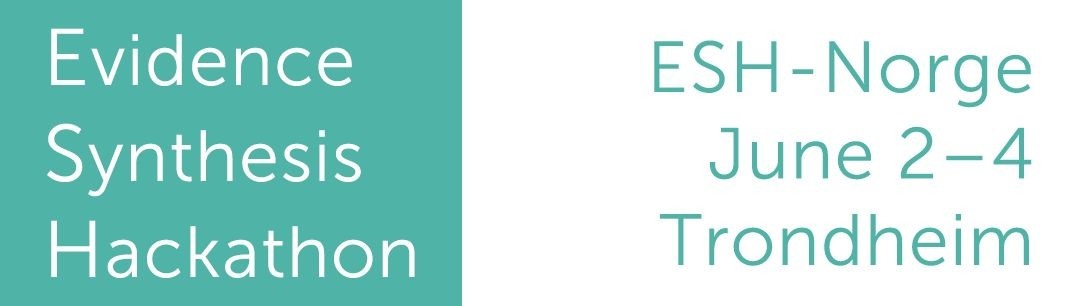
     ESHackathon is coming to Norway! ESH-Norge is a hands-on, collaborative event for people working with systematic reviews, evidence maps, meta-analysis, methods and decision support across disciplines.

When: June 2-4 | Trondheim

Apply now: https://bit.ly/ESH-Norge

Image description

Professor Matthew Grainger (CEE Trustee) is a co-organizer of the ESHackathon.

From the Journal

Environmental Evidence is published by Springer Nature

New Evidence Syntheses and Protocols


Characterising ecosystem service provision by two morphologically distinct kelp species (Laminaria hyperborea and Saccharina latissima) and the biophysical drivers shaping these services: a systematic map protocol (Early Access)

Benjamin Hall, Partick Eskuche-Keith, Yaofa Ren, Pippa Jane Moore, Clare Fitzsimmons & Fabrice Stephenson

https://doi.org/10.1186/s13750-026-00385-w


A systematic map protocol to identify evidence for the environmental occurrence and toxic effects of the tire additive 6PPD (Early Access)

Katryna J. Seabrook, Julie E. Adams, Stacey A. Robinson, Markus Brinkmann, Tanya M. Brown, Jonathan K. Challis, Leah Chibwe, Sarah Marteinson, Danielle Philibert, Ryan S. Prosser & Diane M. Orihel

https://doi.org/10.1186/s13750-026-00383-y


What is the adsorption efficiency and capacity of biodegradable polymer blend foams filled with carbonaceous materials in the removal of heavy metals from water? A systematic review protocol (Early Access)

Lesia Sydney Mokoena, Pennie Petrus Mokolokolo & Julia Puseletso Mofokeng

https://doi.org/10.1186/s13750-026-00384-x


Global evidence for the ecological effects of greening of grey infrastructure: a systematic review protocol

Jessica R. Allen, Louise B. Firth, Melanie J. Bishop, Katherine A. Dafforn, Ferrante Grasselli, Mick E. Hanley, Antony M. Knights, Mariana Mayer-Pinto, Abigail McQuatters-Gollop, Kathryn A. O’Shaughnessy, Francesca Porri, Rebecca K. Smith, Elisabeth M.A. Strain & Anaëlle J. Lemasson

https://doi.org/10.1186/s13750-026-00382-z


What research exists on the presence of 6PPD-Q in different environmental media? A systematic map protocol

Sultan Aljohani, Mary Engels & Kenneth E. Wallen

https://doi.org/10.1186/s13750-026-00380-1


What evidence exists on the impacts of human activities on biodiversity and carbon capacity in North-East Atlantic blue carbon ecosystems: a systematic map protocol

Zina Kebir, Vera Helene Hausner, Ann Eileen Lennert, Amanda Poste & Carmen B. de los Santos

https://doi.org/10.1186/s13750-025-00379-0

New from the AI Special Collection

Assessing the effectiveness of ontology-grounded AI term extraction using OntoGPT for environmental evidence synthesis

Ryan Y. Hodgson, Steven A. Robinson, Amélie C. Boutin, Felix K. Chan, Joseph R. Bennett, Rachel T. Buxton, J. Harry Caufield, Dalal E. L. Hanna & Tim Alamenciak

https://doi.org/10.1186/s13750-026-00381-0

Special Collection: The current and future use of artificial intelligence for systematic evidence synthesis in environmental management

Browse the collection

Happy Earth Day!

Planet Earth (Africa, Europa, Asia) painted by watercolor

          Photo by Elena Mozhvilo on Unsplash

JOIN OUR MAILING LIST

Copyright © 2025 Collaboration for Environmental Evidence

Newsletter Editor: Natalie Dubois

AI Disclosure: The ideas and primary text in this newsletter are the work of human authors. We may use AI tools to assist with editing, but our human review team reads and approves all final content.

If you would like to unsubscribe, please click here.